What to Do After a Car Accident in California: A Complete Guide
What to do after a car accident in California comes down to four jobs: get everyone safe, meet your legal duties at the scene, report the crash on time, and start the property damage claim with good records. Some deadlines run for days, months and years.
Collision Assistant helps California drivers with the vehicle side of a crash: the claim, the repair shop, the rental and the paperwork. In our work, most delays start on the repair side: a car left at a tow yard, an estimate that misses hidden damage, or a rental that ends before the repair does.
What should you do in the first few minutes after a car accident?
In the first few minutes after a car accident, stop, check yourself and your passengers for injuries, and call 911 if anyone is hurt. The California Driver Handbook says to move your vehicle out of traffic if no one is hurt, and then call 911.
Stopping after a crash is a legal duty in California. Vehicle Code 20001 requires a driver in a crash that injures or kills anyone to stop immediately at the scene. Leaving the scene of an injury crash is punishable by state prison or up to one year in county jail, a fine of $1,000 to $10,000, or both.
Under Vehicle Code 20003, a driver in an injury crash must also give their name, address and registration details, show a driver's license on request, and give reasonable help to anyone injured, including a ride to medical care if needed.
If you hit a parked car or other property
A crash that damages only property still requires a stop. Vehicle Code 20002 says the driver must stop at the nearest safe location and either give their name and address to the owner or leave a written note in a conspicuous place on the damaged car or property. A driver who leaves a note must also notify city police, or the CHP in unincorporated areas, without unnecessary delay.
If someone hits your car and drives off, see what to do after a hit and run.
What information should you exchange after a car accident in California?
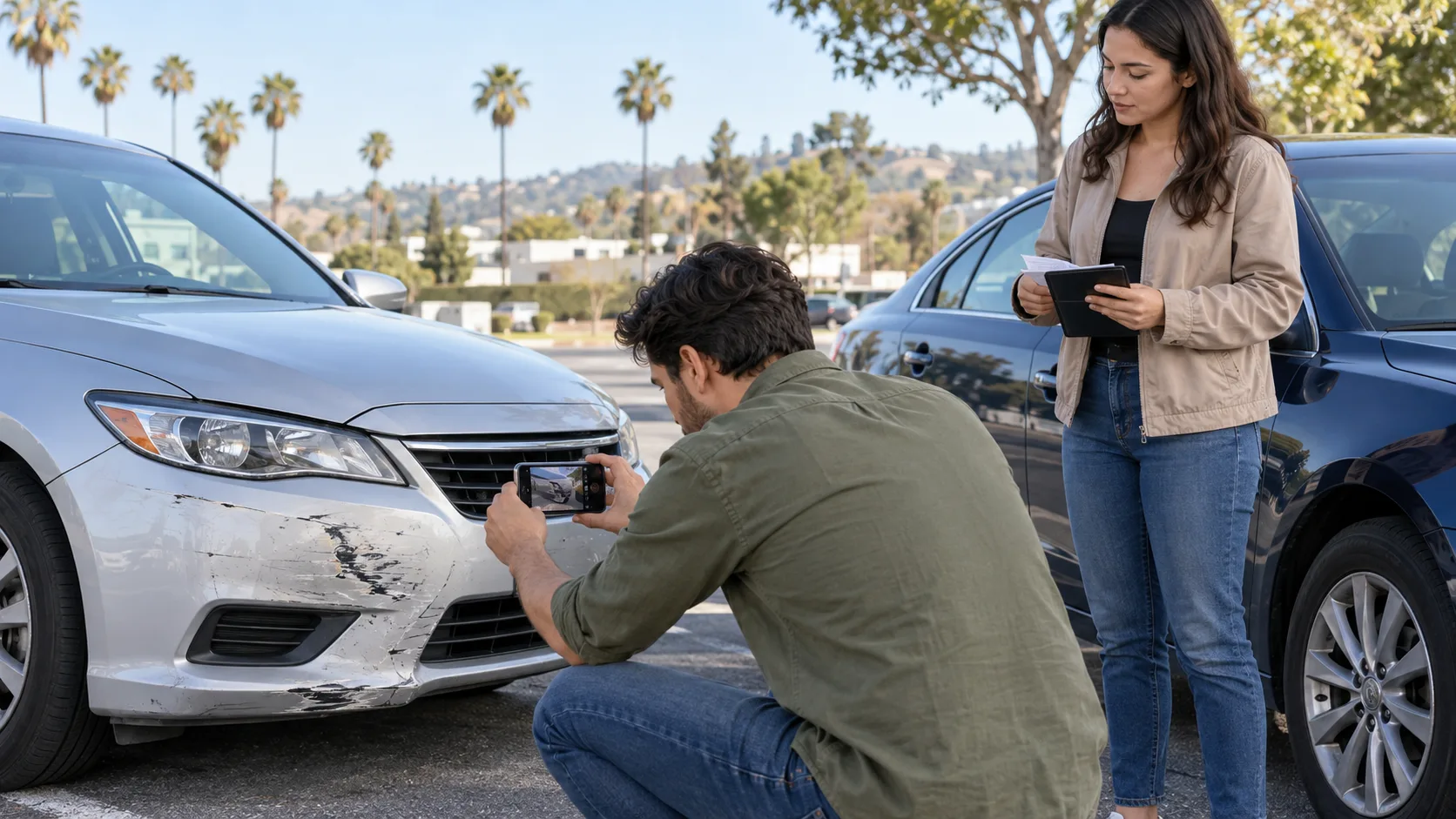
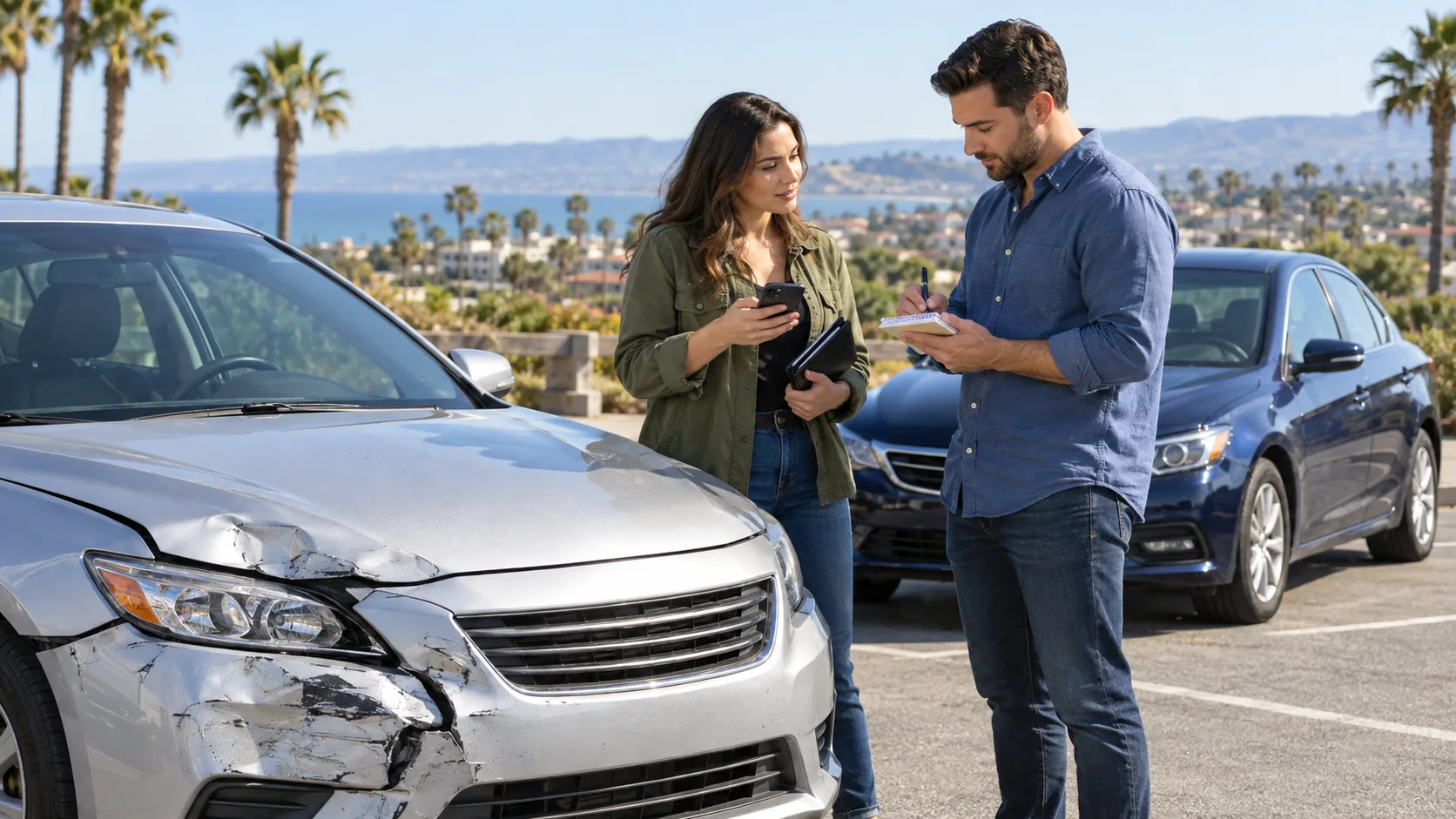
California drivers must exchange identity and insurance details after a crash. Vehicle Code 16025 covers four groups of details: who you are, your license, your vehicle and its owner, and your insurance. Skipping the exchange is an infraction with a fine of up to $250.
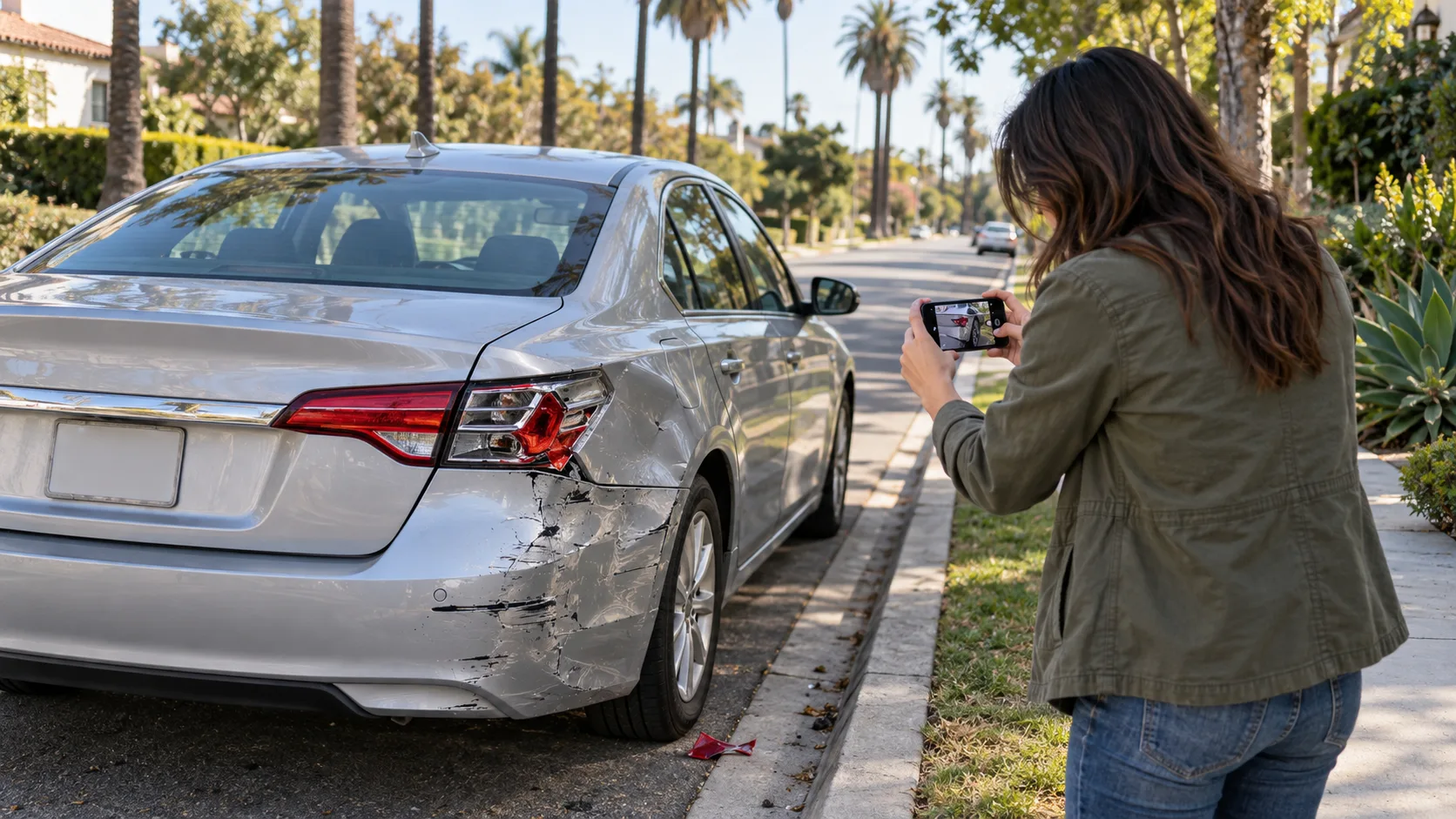
If it is safe, take photos before anything is towed. Our guide to photos and information to get at the scene lists each shot and why it matters later, and our printable car accident checklist fits in a glove box.
Do you have to call the police after a car accident in California?
You must report to police when anyone is injured or killed. Vehicle Code 20008 says the driver must make, or cause to be made, a written report to the CHP, or to city police if the crash happened in a city, within 24 hours. If someone dies and no officer is at the scene, Vehicle Code 20004 requires a report without delay to the nearest CHP office or police department.
Write down the officer's name, agency and report number before you leave. You can later request a CHP crash report on form CHP 190; see our guide on the car accident police report.
Do you have to report a car accident to the DMV?
Under Vehicle Code 16000, each driver must file form SR-1 within 10 days when property damage to any one person is over $1,000 or anyone is injured or killed. The SR-1 is required regardless of fault, and an insurance agent, broker or legal representative may file it for you.
A common myth is that the police report takes care of the DMV. It does not: the DMV handbook says law enforcement will not make the report for you, and opening a claim with your insurer is a separate step too. Skipping a required SR-1 can cost you your license, because Vehicle Code 16004 tells the DMV to suspend drivers who do not report.
If you are not sure whether the damage is over $1,000, a written repair estimate gives you a number. Our guide to the California SR-1 form walks through each part.
When should you see a doctor after a car accident?
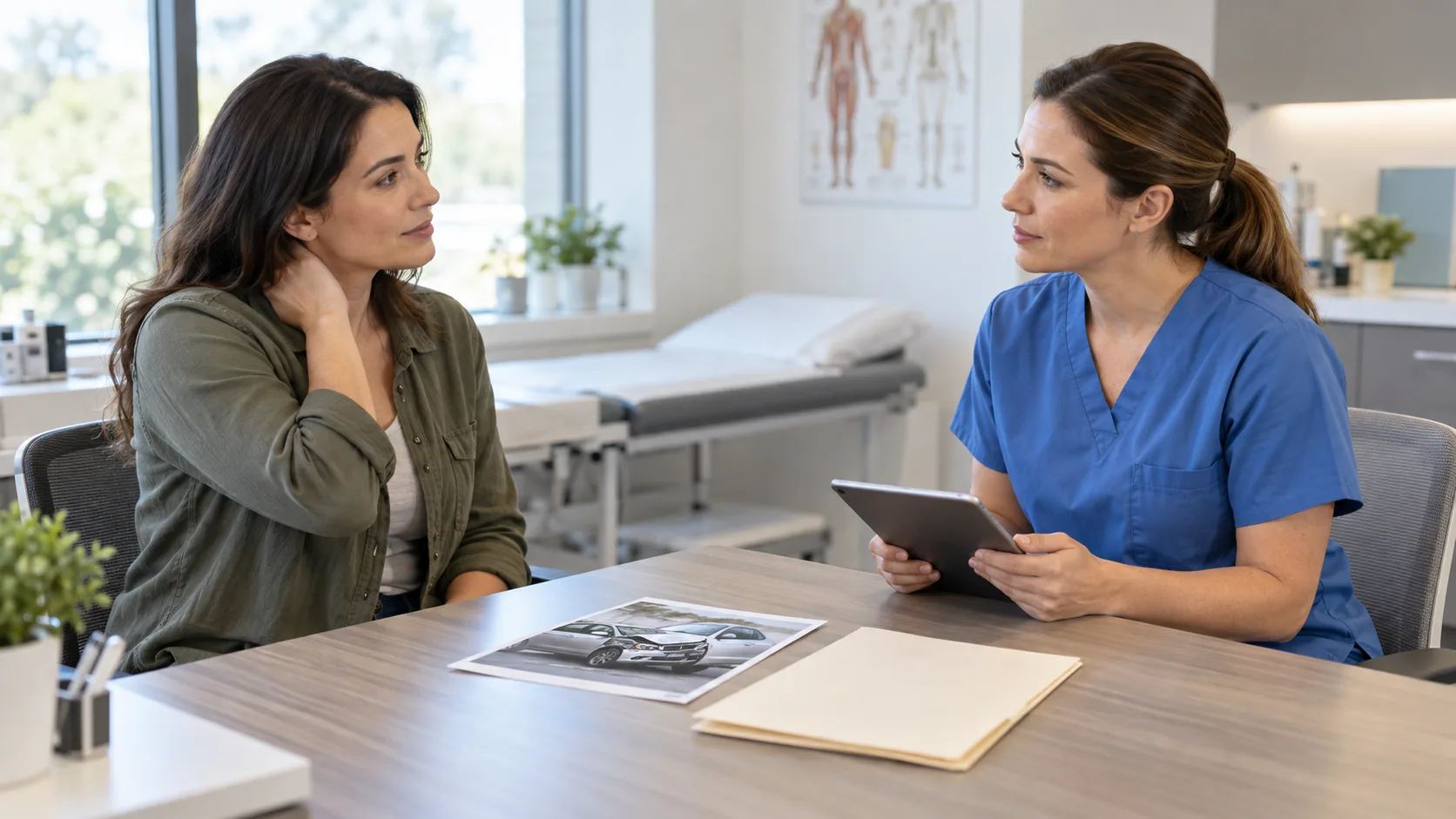
Get checked by a doctor after a crash, even if you feel fine. MedlinePlus says whiplash pain may not appear right away and can take hours to weeks to develop. The CDC says some concussion symptoms may not appear for hours or days after the injury.
The CDC lists danger signs that need emergency care right away, such as a headache that gets worse and does not go away. Our guide on delayed injury after a car accident explains what to watch for. This is not medical advice.
How do you start the insurance claim after a car accident?
Start the claim by reporting the crash to your own insurer, and to the other driver's insurer if you believe the other driver caused it. See how to file a car insurance claim.
California's Fair Claims Settlement Practices Regulations set the insurer's clock. Under 10 CCR 2695.5, the insurer must acknowledge a claim within 15 calendar days of notice and begin any needed investigation. Under 10 CCR 2695.7, the insurer must accept or deny the claim within 40 calendar days after proof of claim, and pay within 30 calendar days of accepting it.
California follows pure comparative negligence, so a driver who is partly at fault can still recover damages, reduced by their share of fault. See our guide to a not-at-fault accident and our full car accident insurance claim guide.
For policies issued or renewed on or after January 1, 2025, California's minimum liability coverage includes $15,000 for property damage, up from $5,000 (Vehicle Code 16056, as changed by SB 1107).
How do you handle repairs, the rental and a possible total loss?
You choose who repairs your car. Insurance Code 758.5 says no insurer may require that a car be repaired at a specific shop, and once you choose a shop, the insurer may not suggest a different one. Comparing a few shops before you commit is worth the time, as one driver told us:
"I almost went with the first shop that popped up on Google. Glad I didn't, that one had some rough reviews I only saw because Collision Assistant had them side by side with two others. Went with a higher-rated one a few miles further out. Worth the extra drive."
Kevin B., Modesto
Our guide on how to find a collision repair shop covers what to compare.
Repair estimates and hidden damage
A California repair shop must give you a written estimate for parts and labor before it starts work, and it may not charge more without your consent (Business and Professions Code 9884.9). The first estimate is often not the final number. Hidden damage found at teardown goes back to the insurer as a supplement, which is a normal step; see hidden damage after a car accident and how to read a collision repair estimate.
Towing, storage and the rental
Move a non-drivable car out of a tow yard quickly; Collision Assistant can coordinate that tow. Under 10 CCR 2695.8(k), insurers must pay reasonable towing and storage charges needed to protect the vehicle, but they only have to give reasonable notice before they stop paying storage.
On a claim against the other driver, loss of use under CACI 3903M is the reasonable cost to rent a similar car for the time reasonably needed to repair or replace yours. Our guide to a rental car after an accident explains how extensions work.
If the car may be a total loss
In a total loss, 10 CCR 2695.8(b) lets the insurer pay the cost of a comparable car, less any deductible, plus applicable taxes and one-time transfer fees. Read how California insurers decide a total loss before you accept a number, and see our guide to a diminished value claim if your car is repaired but now worth less.
What are the deadlines after a car accident in California?
The deadlines after a car accident in California start at the scene and run for up to three years.
| When | What happens | Source |
|---|---|---|
| Immediately | Stop at the scene of an injury or property damage crash | Vehicle Code 20001, 20002 |
| Within 24 hours | Written report to CHP or city police if anyone is injured or killed | Vehicle Code 20008 |
| Within 10 days | SR-1 to the DMV if damage to any one person is over $1,000 or anyone is hurt | Vehicle Code 16000 |
| Within 10 business days | Report to your insurer for uninsured motorist property damage coverage | Insurance Code 11580.26 |
| Within 15 calendar days of notice | Insurer acknowledges the claim and begins any needed investigation | 10 CCR 2695.5 |
| Within 40 calendar days of proof of claim | Insurer accepts or denies the claim, or explains in writing what it still needs | 10 CCR 2695.7 |
| Within six months | Claim against a California public entity, such as a city vehicle | Government Code 911.2 |
| Within two years | Personal injury lawsuit | CCP 335.1 |
| Within three years | Lawsuit for vehicle or other property damage | CCP 338(c) |
What to do after a car accident: your first-week checklist
In the first week after a car accident, handle your health, the reports, the claim and the car, in that order.
- Write down the date, time, location and direction of travel.
- Collect the other driver's information required by Vehicle Code 16025, plus the police report number if officers came.
- Get checked by a doctor, even if you feel fine.
- Report the crash to your insurer and write down the claim number and adjuster's name.
- File the SR-1 with the DMV within 10 days if damage is over $1,000 or anyone was hurt.
- Move a non-drivable car from the tow yard to the repair shop you choose.
- Get a written repair estimate and keep a copy.
- Confirm who is paying for the rental and when the coverage ends.
- Keep every receipt, estimate, photo and letter in one folder.
Common mistakes after a car accident
Common mistakes after a car accident often start small, with a word at the scene or a missed form. Our list of car accident mistakes to avoid goes deeper; these are the ones to watch most closely:
- Admitting fault at the scene before anyone knows what happened.
- Assuming the police report covers the DMV SR-1.
- Treating the first estimate as final when teardown can find more damage.
- Letting the rental run out without asking for an extension backed by the shop's timeline.
- Signing a release or accepting a total loss value before checking the comparables.
How Collision Assistant helps
Collision Assistant handles the vehicle side of a California crash. Our property damage claim management service starts with intake: your photos, police report number, claim numbers, vehicle details, and which coverage the repair runs through.
- We check that every shop we recommend holds an active Bureau of Automotive Repair registration before we recommend it.
- Through our free body shop recommendation, we match your car to a vetted shop by make, damage type and location. If you already picked a shop, we never steer you away from it.
- We track supplements, parts delays and completion dates when teardown finds hidden damage.
- We coordinate the rental with the paying carrier and request extensions ahead of the cutoff, backed by the shop's timeline.
- We keep estimates, supplements, invoices, rental records and photos in one file under one case number.
Getting Your Car, and Your Peace of Mind, Back
If you remember nothing else about what to do after a car accident, let it be this: take care of the people first, handle the required reports, and don't rush the repair. Being involved in a car accident in California is stressful enough without fighting the cleanup alone, and every California car accident eventually comes down to one question, how do I get my car whole again. That's the part we can take off your plate.
When you're ready to move forward, we'll help you find and connect with a vetted, verified California repair shop and request a repair quote, all for free. You handle the healing and the paperwork; let us handle the car. If you've ever frozen up in the middle of a car crash, what to do next can feel impossible, and this guide exists to make that blank feeling shorter. Reach out through our site whenever you're ready.