Car Accident Checklist: What to Do at the Scene
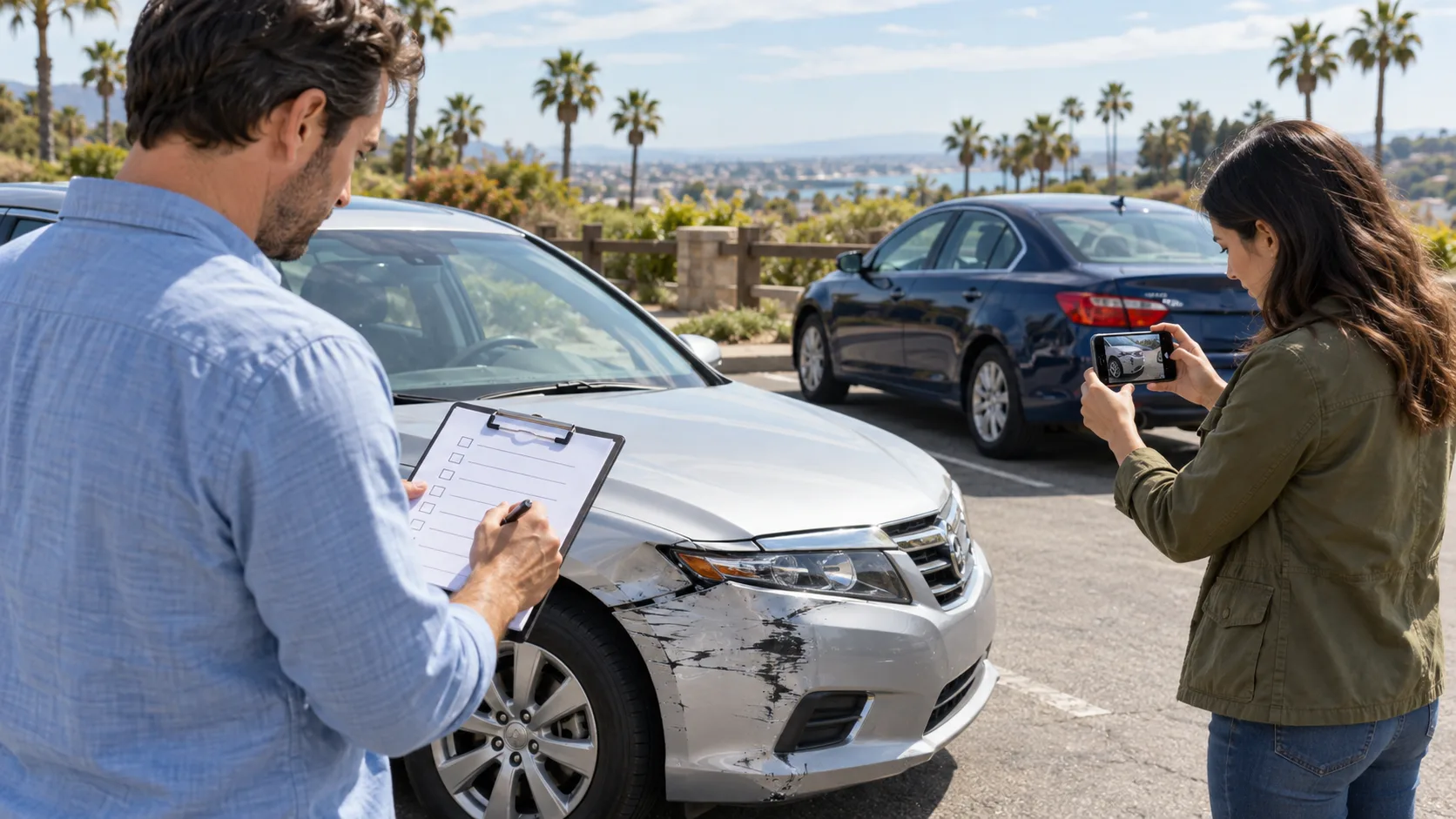
A car accident checklist for the scene has one job: help you do the right things in the right order while you are shaken up. Stop, get safe, call 911 if anyone is hurt, exchange the information California law requires, take photos, and note the details before the cars are moved or towed. The whole list fits on one page.
This checklist is for California drivers who just had a crash, or who want a copy in the glove box before one happens. Collision Assistant helps drivers with the vehicle side of a crash, and we see the same gaps in the files drivers bring us: no plate photo, no police report number, no note of where the car was towed. This list is ordered to close those gaps.
For the full picture of the days and weeks after the scene, see our guide on what to do after a car accident. This page stays at the scene.
The car accident checklist: what to do at the scene, in order
This car accident checklist follows the order that keeps people safe first and protects your claim second. Print it, or save it on your phone.
- Stop. Stop at the scene or the nearest safe spot. Turn on your hazard lights.
- Check for injuries. Check yourself, then your passengers, then the people in the other car.
- Call 911 if anyone is hurt. Also call if the road is blocked or a driver seems impaired.
- Move out of traffic if no one is hurt. If the cars can be driven, move them to the shoulder or a nearby lot.
- Stay calm and stick to facts. Do not argue about fault or say "it was my fault."
- Exchange the required information. Get the details listed in the next section, and show your own license, registration and proof of insurance.
- Photograph the scene before anything moves. Wide shots first, then every damaged area, then the other car's license plate.
- Get witness names and phone numbers. Witnesses often leave within minutes.
- Get the officer's name and the report number. If police come, ask for both before you leave.
- Note the details. Write the date, time, street names, direction of travel, weather and light.
- Write down the tow details. Get the tow company name, the driver's phone number and the address of the yard where your car is going.
- Do not sign anything except police paperwork. Releases and repair authorizations can wait until you have a written estimate.
What information does California law say you must exchange?
California law sets the minimum information drivers exchange at the scene. Vehicle Code 16025 requires each driver, unless unable, to give other drivers and property owners present their name and address, driver's license number, vehicle identification number, the registered owner's address, and the insurer's name and address and policy number. Failing to comply is an infraction with a fine of up to $250.
The registered owner and the driver may be two different people. A borrowed car, a company car or a family car often has an owner who was not driving. Write down both names, because the claim runs through the owner's insurance policy.
California also requires drivers to carry proof of insurance. Under Vehicle Code 16028, a driver must show proof of financial responsibility when a peace officer asks, including at a crash, and may show it on a phone.
Scene information checklist
| Get this | Where to find it | Why it matters later |
|---|---|---|
| Other driver's name, address and license number | Driver's license | Identifies the at-fault party for the claim |
| Registered owner's name and address | Registration card | The claim runs through the owner's policy |
| Insurer name and policy number | Insurance card or phone app | Lets you open a claim with the other carrier |
| License plate and VIN | Plate; VIN on the registration or windshield corner | Confirms the car if other details turn out wrong |
| Police officer name, agency and report number | Ask the officer | Insurers and the DMV ask for it |
| Witness names and phone numbers | Ask people who stopped | Helps when drivers disagree about fault |
| Tow company and yard address | Ask the tow driver | You need it to move the car to a shop and limit storage days |
Do you have to call the police at the scene?
When anyone is hurt or killed, the law requires a police report. Under Vehicle Code 20008, the driver has 24 hours to make, or cause to be made, a written report to the CHP or, in a city, the city police. At the scene, call 911 for help and write down the officer's name and the report number.
For a crash with no injuries, the California Driver Handbook says to move your vehicle out of traffic and then call 911. Our guide on the car accident police report explains when a report helps your claim even if one is not required.
What if someone is hurt at the scene?
If someone is hurt, call 911 first. Vehicle Code 20001 requires a driver in an injury or fatal crash to stop immediately, and Vehicle Code 20003 requires the driver to give reasonable help to anyone injured, including a ride to medical care if it is needed or requested.
Leaving the scene of an injury crash is a crime in California. Under Vehicle Code 20001, it is punishable by state prison or up to one year in county jail, a fine of $1,000 to $10,000, or both.
Even if no one feels hurt, add one more step after you leave the scene: get checked by a doctor. MedlinePlus notes that whiplash pain can take hours to weeks to show up, and the CDC notes that some concussion symptoms can take hours or days. This is not medical advice; our guide on delayed injury after a car accident covers the warning signs.
What if you hit a parked car?
If you hit a parked car, stop and find the owner or leave a note. Vehicle Code 20002 requires the driver to give their name and address to the owner, or leave a written note in a conspicuous place on the car, and then notify city police or the CHP without unnecessary delay.
Example: You back into a parked car at a grocery store and nobody comes out after a few minutes. You write your name, address and phone number on a note, put it under the wiper, photograph the note and the damage, and then call the local police non-emergency line. That covers the steps in Vehicle Code 20002 (this scenario is hypothetical).
If someone else drives off after hitting your car, see what to do after a hit and run.
Which photos should you take before leaving the scene?
Take photos before the cars are moved or towed, if it is safe. Start with wide shots that show both cars, the lanes and nearby signs, then take close-ups of every damaged area on both cars and a clear shot of the other car's license plate.
The tow truck takes your car, and its damage, with it. Our guide to photos and information to get at the scene lists every shot and explains how each one is used later in the property damage claim.
What to do before your car is towed
Before your car is towed, write down the tow company, the driver's phone number and the yard address. Take your registration, insurance card, garage remote and any valuables out of the car. Drivers often lose track of a towed car for days, and storage charges can run the whole time.
The insurer's duty to pay for storage has a limit. 10 CCR 2695.8(k) has insurers pay reasonable towing and storage needed to protect the car, and lets them stop paying storage after giving reasonable notice. Moving the car to the repair shop you choose ends the yard's daily charges, and Collision Assistant can coordinate that tow for a non-drivable car.
The tow driver does not get to pick your shop, and neither does an insurer. Under Insurance Code 758.5, an insurer cannot make you use a particular repair shop. Our guide on how to find a collision repair shop explains what to compare.
What to keep in your glove box
A small kit in the glove box makes this checklist easy to follow. Keep these items in the car:
- A printed copy of this checklist.
- Your current registration card.
- Proof of insurance, on paper or on your phone (Vehicle Code 16020 requires evidence of financial responsibility in the vehicle).
- A pen and a small notepad.
- A phone charger.
- Emergency contact numbers written on paper, in case your phone is damaged.
Common mistakes at the scene
The most common mistakes at the scene are small, and they show up weeks later in the claim. Watch for these:
- Saying "I'm sorry" or "it was my fault" before anyone knows what happened.
- Leaving without the other driver's insurance details or plate number.
- Taking close-up photos only, with no wide shot that shows where the cars ended up.
- Not writing down where the tow truck is taking the car.
- Assuming the police will file the DMV SR-1, which they will not.
Our guide to car accident mistakes to avoid covers the errors in the weeks after the scene.
How Collision Assistant helps
Once you leave the scene, Collision Assistant can take the next steps on the vehicle side with you. Our property damage claim management starts with your scene notes: photos, police report number, claim numbers and vehicle details. Many drivers leave the scene with no idea which shop to trust, as one driver told us:
"I rear-ended someone in stop-and-go traffic and my front end was a mess. I'm not a car person, I had no frame of reference for who's good and who isn't. Reading real reviews on here is what made the decision for me. Picked a place, the work was solid, done in four days."
Marcus L., Riverside
Here is what happens after you hand us your scene notes:
- We coordinate towing to get a non-drivable car from the scene or a tow yard to the right shop.
- Through our free body shop recommendation, we place your car with a vetted shop that holds an active Bureau of Automotive Repair registration, checked before we recommend it.
- If you already have a shop in mind, we never steer you away from it.
- We keep your scene photos, estimates and insurer letters in one file under one case number.
Getting Your Car, and You, Back on Track
A crash scrambles your thinking for a few minutes, and that's exactly when a car accident checklist earns its keep. Take care of the people first, gather what you can, report what California requires, and let the rest wait until you're somewhere calmer. None of it has to be perfect. You just have to get through it.
When you're ready to deal with the car, we'll help you find and connect with a vetted, verified California repair shop and request a repair quote, all for free. Print the checklist, stash it in your glovebox, and reach out through our site whenever you need us. We'll take it from there.