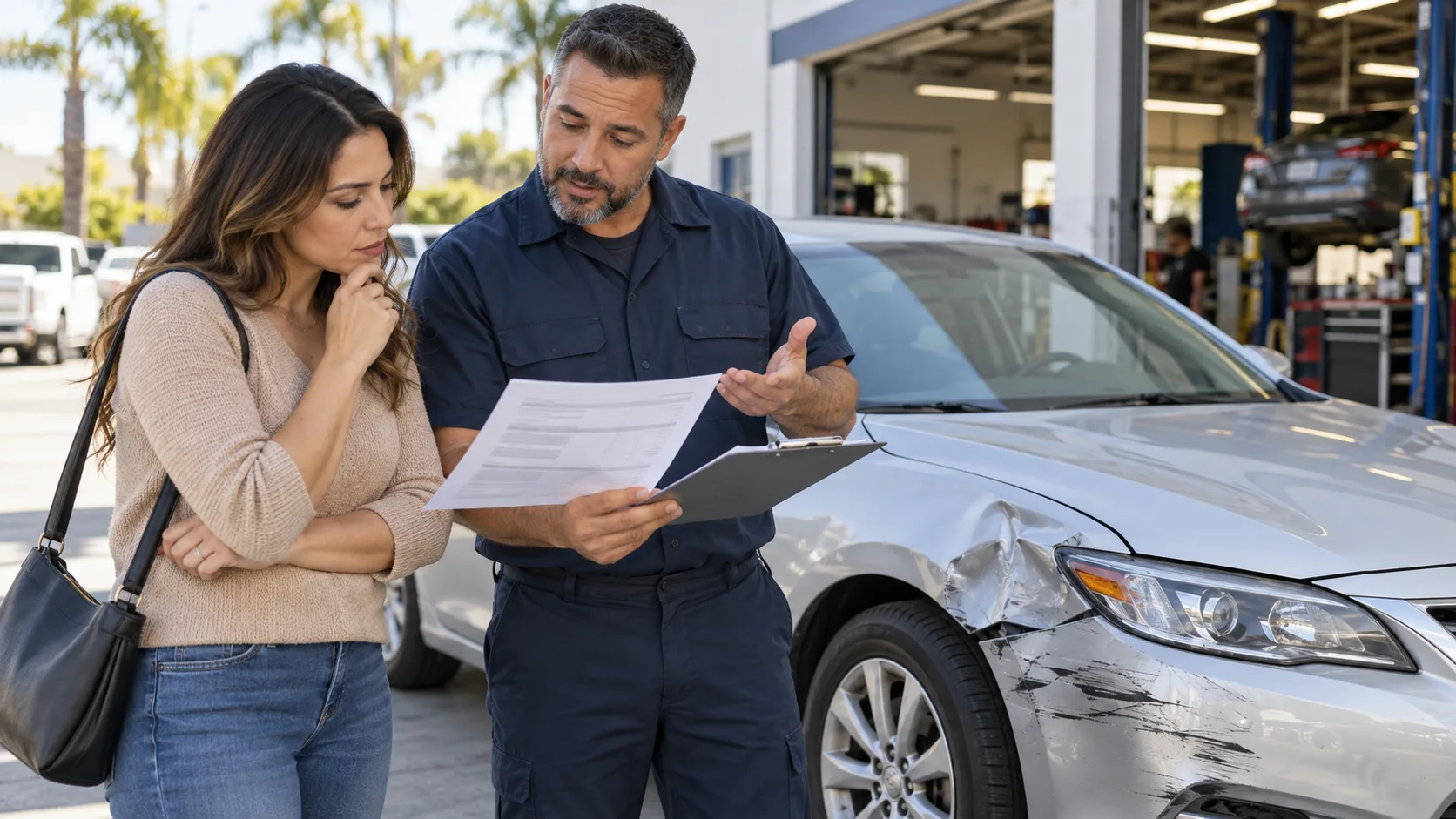
Car Accident Insurance Claim: The Complete California Guide
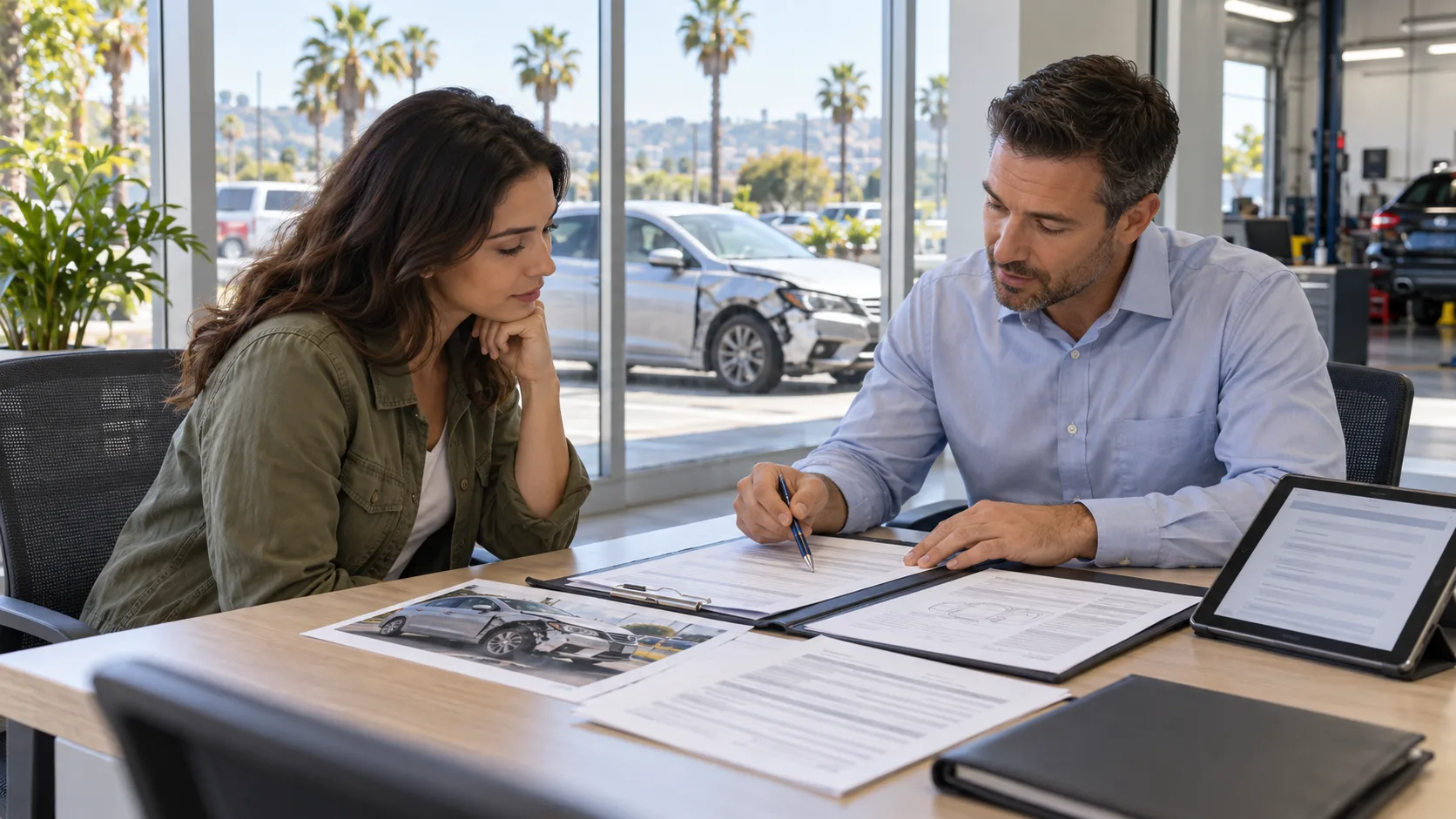
A car accident insurance claim is your request for an insurer to pay for crash losses, such as repairs, a rental car or a total loss payment. In California, you can claim on your own policy (a first-party claim) or against the at-fault driver's policy (a third-party claim). State regulations set deadlines for how fast the insurer must respond either way.
If you just had a crash in California, this guide covers who pays, which coverage applies, both sides' deadlines and where claims stall.
Collision Assistant helps California drivers with the vehicle side of a claim, from shop placement to supplements, rental coordination and one organized file. We work on the repair side, and that is where most claim delays start: hidden damage found at teardown, parts waits and rental cutoffs.
How does a car accident insurance claim work in California?
A car accident insurance claim in California starts when you notify an insurer of the loss and ends when the insurer pays, denies or closes the claim. In between, the insurer investigates, inspects the car, decides fault and coverage, and approves a repair or a total loss payment.
The California Department of Insurance (CDI) regulates how insurers handle claims through the Fair Claims Settlement Practices Regulations, 10 CCR 2695.1 and following. These rules set response deadlines, require written reasons for first-party denials and bar unreasonably low settlement offers.
Fault matters because California uses "pure" comparative negligence. Under Li v. Yellow Cab Co. (1975), your own share of fault does not bar recovery, but it reduces your recovery in proportion to that share.
What is the difference between a first-party and a third-party claim?
A first-party claim is a claim on your own insurance policy. California's regulations define a first-party claimant as a person asserting a right under a policy "as a named insured, other insured or beneficiary," including people seeking uninsured motorist benefits (10 CCR 2695.2).
A third-party claim is a claim against someone else's insurance, usually the at-fault driver's property damage liability coverage. A third-party claim avoids your deductible, but payment depends on the other insurer accepting that its driver was at fault.
| Question | First-party claim | Third-party claim |
|---|---|---|
| Whose policy pays | Your own insurer | The at-fault driver's insurer |
| Coverage used | Collision, comprehensive or uninsured motorist property damage | Property damage liability |
| Your deductible | Applies; your insurer may seek it back through subrogation | Does not apply |
| Diminished value | Generally not paid (Baldwin v. AAA, 2016) | May be claimed (CACI 3903J) |
| CDI auto claims mediation | Available if CDI's dollar thresholds are met | Not available |
If someone else caused the crash, your insurer may later seek repayment from the other insurer, which is called subrogation. Under 10 CCR 2695.7(p) and (q), your insurer must generally tell you in writing whether it will pursue subrogation and must include your deductible in every subrogation demand. Our not-at-fault accident guide covers both routes.
Which coverage types pay for what after a crash?
Each coverage on a California auto policy pays for a different kind of loss. The table below uses the definitions in the CDI auto insurance guide.
| Coverage | What it pays | Key limit or rule |
|---|---|---|
| Property damage liability | Property damage you cause someone else | Minimum $15,000 for policies issued or renewed on or after January 1, 2025 (Vehicle Code 16056) |
| Bodily injury liability | Injuries you cause someone else | Minimum $30,000 per person and $60,000 per accident, same effective date (Vehicle Code 16056) |
| Collision | Damage to your car from contact with another vehicle or an object | Optional; does not meet the legal insurance requirement on its own |
| Comprehensive | Damage to your car from something other than a collision | Optional; does not meet the legal insurance requirement on its own |
| Uninsured motorist property damage | Damage to your car from an at-fault uninsured driver | Up to $3,500 or the car's actual cash value, whichever is less (Insurance Code 11580.26) |
| Rental reimbursement | A rental while your car is repaired after a covered accident | Optional coverage |
What deadlines does the insurer have to meet?
California insurers have 15 calendar days to acknowledge a claim and start investigating, under 10 CCR 2695.5(e), then 40 calendar days after proof of claim to accept or deny it, under 10 CCR 2695.7.
| Insurer duty | Deadline | Rule |
|---|---|---|
| Acknowledge the claim, send forms, start investigating | 15 calendar days after notice of claim | 10 CCR 2695.5(e) |
| Accept or deny the claim | 40 calendar days after proof of claim | 10 CCR 2695.7(b) |
| Explain in writing why more time is needed | Within the 40 days, then every 30 calendar days | 10 CCR 2695.7(c)(1) |
| Pay an accepted claim | 30 calendar days after acceptance | 10 CCR 2695.7(h) |
| Warn a claimant without a lawyer before a time limit expires | At least 60 days before (30 days for uninsured motorist claims) | 10 CCR 2695.7(f) |
The 40-day clock runs from "proof of claim," meaning evidence in the insurer's file that reasonably supports the amount of the loss, including documents you submit (10 CCR 2695.2).
What deadlines apply to you?
Drivers have their own deadlines, and some are short. Policies may add notice rules, such as for hit-and-run crashes, says the CDI accident guide.
- DMV SR-1 report: within 10 days if property damage to anyone exceeds $1,000 or anyone is hurt or killed (Vehicle Code 16000). See our California SR-1 form guide.
- Uninsured motorist property damage: report the crash to your own insurer within 10 business days (Insurance Code 11580.26).
- Total loss comparables: tell your insurer within 35 calendar days of the payment or final offer if you cannot find a comparable car for that amount (10 CCR 2695.8(c)).
- Claims against a California public entity: present the claim within six months (Government Code 911.2).
- Lawsuits: three years for vehicle damage (Code of Civil Procedure 338(c)) and two years for personal injury (Code of Civil Procedure 335.1).
Injury claims follow separate rules. The CDC says some concussion symptoms may not appear for hours or days, so get checked by a doctor and see our guide on delayed injury after a car accident. This is not medical advice.
What are the stages of a car accident insurance claim?
Most California claims move through the same stages. Our guide on how to file a car insurance claim covers the filing stage.
- Report the crash where the law requires it, including the DMV SR-1.
- Give notice of claim to your insurer, the other driver's insurer, or both, and write down each claim number.
- The insurer acknowledges the claim and starts investigating within 15 calendar days.
- The car is inspected and an estimate is written, at the shop you choose.
- The insurer decides coverage and fault within 40 calendar days after proof of claim.
- The shop repairs the car, and hidden damage found at teardown goes back to the insurer as a supplement.
- If the car is a total loss, the insurer values it under 10 CCR 2695.8(b).
- The insurer pays within 30 calendar days of accepting the claim.
- You inspect the finished repair with a post-repair inspection checklist and keep every estimate, invoice and letter in one file.
Do you have to use the insurance company's repair shop?
No. A common myth says you must use the insurer's shop, but Insurance Code 758.5 says "No insurer shall require that an automobile be repaired at a specific automotive repair dealer." An insurer may recommend a shop only if you ask for a referral or you were told in writing that you have the right to choose.
Once you pick a shop, the insurer may not suggest a different one. Under 10 CCR 2695.8(e), the insurer also may not require an inspection at its direct repair program (DRP) shop after you choose yours. For tips on picking a shop, read how to find a collision repair shop.
One Riverside driver described choosing a shop after a crash:
"I rear-ended someone in stop-and-go traffic and my front end was a mess. I'm not a car person, I had no frame of reference for who's good and who isn't. Reading real reviews on here is what made the decision for me. Picked a place, the work was solid, done in four days."
Marcus L., Riverside
Where do car accident claims usually slow down?
Car accident claims usually slow down on the repair side. These are the stall points we see most.
- Supplements: the first estimate is often written before teardown. See hidden damage after a car accident.
- Rental cutoffs: a rental can end while the shop still waits on parts. See rental car after an accident.
- Storage fees: under 10 CCR 2695.8(k), insurers pay reasonable towing and storage but may stop paying storage after reasonable notice.
- Total loss: comparable cars must be identified by VIN, stock number or plate. See how California insurers decide a total loss.
- Diminished value: usually pursued on a third-party claim. See our diminished value claim guide.
Example (hypothetical): A driver's sedan is rear-ended in Long Beach, and the other insurer approves an estimate written from photos. At teardown, the shop finds a cracked bumper reinforcement and a bent sensor bracket, so it sends a supplement. The rental is set to end in 10 days, so the driver asks for an extension backed by the shop's new completion date.
What if your claim is denied or the offer seems low?
On a first-party claim, a denial must be in writing, list every reason with its factual and legal basis, and tell you that CDI can review the matter, under 10 CCR 2695.7(b). Insurers also may not try to settle any claim with an offer that is "unreasonably low," under section 2695.7(g).
CDI takes complaints online and through its Consumer Hotline at 1-800-927-4357, according to the CDI consumer help page. For first-party physical damage disputes, CDI's free Automobile Claims Mediation Program covers claims over $7,500 with more than $2,000 in dispute.
Our guide to a lowball insurance offer explains how to check the numbers and respond in writing. For legal questions, such as an injury claim or a disputed denial, talk to a licensed California attorney.
Common mistakes
- Waiting weeks on the other insurer's liability decision when your own collision coverage could start the repair sooner.
- Assuming the first approved estimate is the repair price before the shop has taken the car apart.
- Keeping the original rental end date after a supplement has pushed the repair back.
- Paying tow yard storage day after day instead of moving a non-drivable car to the shop.
- Signing a release or a total loss acceptance before the comparable cars have been checked.
- Missing a short deadline, such as the 10-day SR-1 report or the 10-business-day uninsured motorist property damage report.
More pitfalls are in our list of car accident mistakes to avoid.
How Collision Assistant helps
Collision Assistant coordinates the vehicle side of a California car accident insurance claim, and the service is free for drivers. We set up the case with your photos, police report number, claim numbers and vehicle details, then follow the repair until you have the keys back.
- On request, we place your car with a shop in our California network, and we check each shop's Bureau of Automotive Repair registration before we recommend it.
- When the shop finds hidden damage at teardown, it goes to the insurer as a supplement, and we track it along with parts and completion dates.
- We coordinate the rental and request extensions before the cutoff.
- We check total loss valuations against California's comparable vehicle rules and prepare diminished value estimates on third-party claims.
- We keep every estimate, invoice and carrier letter in one file under one case number.
You keep the choice of shop. Learn more about our property damage claim management or ask for a free body shop recommendation. Collision Assistant does not settle claims, represent drivers or give legal advice.
Getting Your Car Moving While the Claim Works Itself Out
Claims run on their own clock, and there's a real limit to how much you can speed one up. What you can control is your half: document thoroughly, respond quickly when the adjuster asks for something, know the deadlines your insurer must meet, and remember the repair decision belongs to you. A car accident insurance claim goes considerably smoother once you know which parts are actually negotiable.
When you're ready to deal with the car, we'll help you find and connect with a vetted, verified California repair shop and request a repair quote, all for free. Having a real estimate in hand tends to make every conversation with an adjuster shorter. Reach out through our site whenever you're ready, and let us handle the part we're good at.