Lowball Insurance Offer After a Car Accident: What to Do
A lowball insurance offer after a car accident is a settlement offer that does not cover the documented cost to repair or replace your car. In California, insurers may not try to settle a claim with an "unreasonably low" offer under 10 CCR 2695.7(g). If an offer looks low, ask for the insurer's estimate or valuation in writing, compare it line by line, and respond in writing with your documents.
In the vehicle claims we see, a low offer often traces back to missing information rather than bad faith. An estimate written from photos misses damage behind the bumper, or a total loss report uses comparable cars that do not match yours. A missing item can often be added with proof.
Collision Assistant works on the repair side of California claims, where these gaps show up. This guide explains why offers come in low, how to check an estimate or a valuation, how to respond in writing, how the California Department of Insurance complaint process works and when to talk to a licensed attorney.
Why do insurance offers come in low?
Many low offers on vehicle claims come from an incomplete estimate or a valuation built on the wrong comparables. The insurer's first estimate is often written from photos or a quick walkaround, before the shop takes the car apart. Damage behind panels, sensor brackets and structural parts can be missed.
Other common reasons include unlisted repair steps, such as ADAS calibration, refinish blending or frame measuring. An estimate may use aftermarket or used parts without saying so. On a total loss, the report may use cars with different trims, options or mileage, or deduct for condition without itemizing it.
A common myth is that the first estimate is the final price. Supplements are normal when teardown finds more damage, so a low first estimate is often the start of the repair record, not the end. See hidden damage after a car accident for why this happens.
What does California law say about lowball offers?
California bars insurers from trying to settle a claim with an unreasonably low offer. The rule is in 10 CCR 2695.7(g), part of the Fair Claims Settlement Practices Regulations enforced by the California Department of Insurance.
To decide whether an offer was unreasonably low, the Insurance Commissioner weighs several factors. They include how far the insurer considered evidence the claimant submitted, the procedures it used to set property damage amounts, and other credible evidence that the offer was below what a reasonable person would offer.
Other rules apply to the vehicle side. Under 10 CCR 2695.8, non-OEM parts on an insurer's estimate must be at least equal to OEM parts in kind, quality, safety, fit and performance, and must be disclosed in writing. Deductions for betterment must be itemized in dollars and limited to parts normally replaced over a car's life, such as tires and batteries.
How do you check a repair estimate?
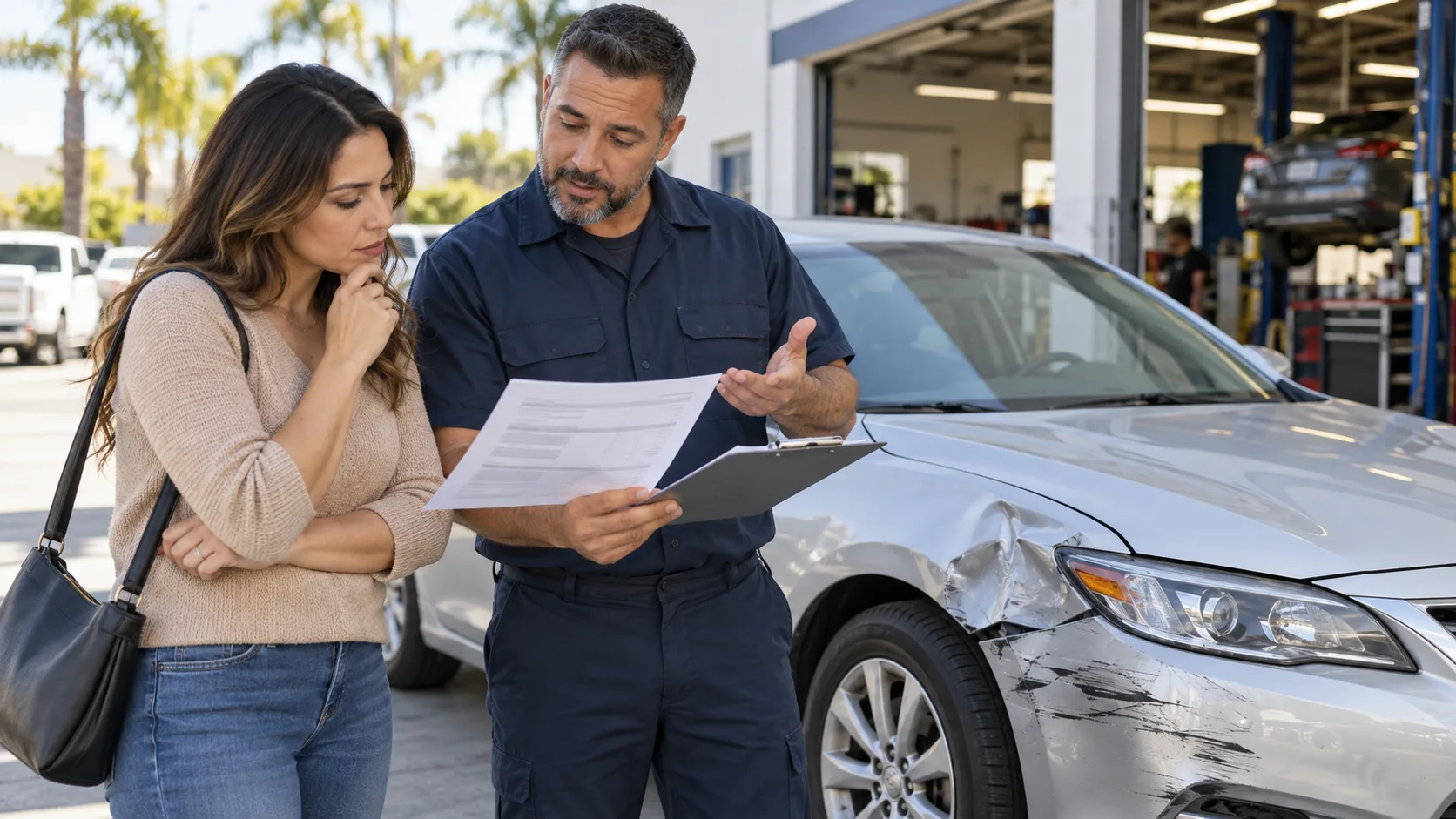
Put the insurer's estimate next to your shop's written estimate and compare them line by line. Look for missing parts, fewer labor hours, missing steps like calibration or blending, and parts listed as aftermarket or used. Each difference is a question to ask in writing.
| What to check | What a gap looks like | California rule |
|---|---|---|
| Parts type | Aftermarket or used parts not disclosed | Non-OEM parts disclosed in writing (10 CCR 2695.8(g)); estimate labels each part (B&P 9884.9(c)) |
| Missing operations | No calibration, blending or frame measuring | Estimate must allow repair to accepted trade standards (10 CCR 2695.8(f)) |
| Labor hours | Fewer hours than your shop lists | Itemized, reasonable adjustments only (10 CCR 2695.8(f)) |
| Betterment | A deduction on body panels with no dollar detail | Itemized in dollars; normally only wear parts like tires and batteries (10 CCR 2695.8(i)) |
| Labor depreciation | Labor reduced on your own policy | Not allowed unless the policy clearly permits it (10 CCR 2695.8(j)) |
| Towing and storage | Charges left out | Reasonable charges paid (10 CCR 2695.8(k)) |
Our guides on how to read a collision repair estimate and OEM vs aftermarket parts explain each line. If the car has driver-assist sensors, see ADAS calibration after a collision.
How do you check a total loss valuation?
Check the comparable cars first. Under 10 CCR 2695.8(b), each comparable must be the same make, the same or newer model year, of like kind and quality, and available in your local market within 90 days. Each must also be identified by VIN, stock number or plate, plus the seller's phone or address.
Then check the adjustments. Condition deductions must be "discernible, measurable, itemized, and specified," and the payment must include applicable taxes and one-time transfer fees for a comparable car. If you cannot find a comparable for the amount offered, tell the insurer within 35 calendar days of the payment or final offer, and the insurer must reopen the file under 10 CCR 2695.8(c).
Most standard policies also have an appraisal clause for total loss disputes, according to the California Department of Insurance accident guide. Read how California insurers decide a total loss for more detail.
How to respond to a lowball insurance offer in writing
Respond to a low offer in writing, with documents, so the claim file shows what you sent and when. A written message that calls for a response must get a reply within 15 calendar days under 10 CCR 2695.5(b).
- Ask the insurer for its estimate or valuation report in writing, if you do not already have it.
- Get a written, itemized estimate from the licensed shop you chose.
- Compare the two line by line and list each difference.
- For a total loss, list each comparable and note any wrong trim, mileage or location.
- Write a short, factual letter or email: your claim number, each item you question, and the documents that support it.
- Attach photos, the shop estimate, any supplement, receipts and your comparable listings.
- Ask the insurer to explain in writing any item it will not change.
- Keep a dated log of every reply, and calendar the 15-day response window.
- Do not sign a release until you understand what it closes.
Stick to facts and documents, not arguments. A complete written record matters because 10 CCR 2695.7(g) lists how far the insurer considered the claimant's evidence as one factor in judging whether an offer was unreasonably low.
How do you file a complaint with the California Department of Insurance?
You can file a complaint with the California Department of Insurance online or through the Consumer Hotline at 1-800-927-4357. CDI's consumer help page recommends the online form, since paper forms can slow the process. Include your claim number, the insurer's letters and your documents.
For first-party physical damage disputes, CDI's free Automobile Claims Mediation Program may apply. It covers claims over $7,500 with more than $2,000 in dispute, including the amount of damage, repair methods and total loss value. The insurer first gets 28 calendar days to resolve the dispute, and the program does not cover third-party liability claims.
An insurer may not require you to withdraw or refrain from a CDI complaint as a condition of settlement, under 10 CCR 2695.7(o). On a first-party claim, a written denial must also tell you that CDI can review it.
When should you talk to a licensed attorney?
Talk to a licensed California attorney when the dispute involves an injury, disputed fault, a denied claim, a release you do not understand, or a deadline close to running out. Lawsuit deadlines are three years for vehicle damage under Code of Civil Procedure 338(c) and two years for personal injury under section 335.1.
The State Bar of California certifies lawyer referral services that can connect you with a licensed attorney. Collision Assistant is not a law firm and does not give legal advice.
Common mistakes
- Accepting an offer or signing a release before checking the estimate or the comparables.
- Arguing by phone with no written follow-up, so the file has no record.
- Disputing the total before checking whether hidden damage found at teardown has simply not been added as a supplement yet.
- Sending a complaint with no claim number or documents attached.
- Letting the rental run out while the dispute is open, without asking for an extension tied to the shop's timeline.
- Assuming you must use the insurer's shop to get paid, when Insurance Code 758.5 lets you choose.
How Collision Assistant helps
Collision Assistant helps California drivers build the repair record that a low offer is checked against, and the service is free for drivers. We coordinate, document and follow up; the insurer decides the offer, and we do not represent drivers or give legal advice.
- On request, we place the car with a shop in our California network for a written, itemized estimate. We check every shop's Bureau of Automotive Repair registration before we recommend it.
- If teardown turns up more damage, the shop's supplement goes to the insurer, and we follow up until the insurer replies.
- For a total loss, we line up each comparable car in the report against the identification and adjustment rules in 10 CCR 2695.8(b).
- Your estimates, supplements, photos and carrier letters stay together under one case number, ready to attach to a written response.
You keep the choice of shop. See property damage claim management or ask for a body shop recommendation. For the whole claim lifecycle, read our car accident insurance claim guide.
Your own shop's written estimate is the yardstick for a low offer, so the shop you pick matters. One Modesto driver compared shops before choosing:
"I almost went with the first shop that popped up on Google. Glad I didn't, that one had some rough reviews I only saw because Collision Assistant had them side by side with two others. Went with a higher-rated one a few miles further out. Worth the extra drive."
Kevin B., Modesto
Getting a Number That Reflects Your Actual Car
Insurance companies see frustration constantly, and it's a reasonable response to a figure that doesn't match reality. It just isn't an effective one. What moves property damage claims is showing the insurer something they haven't seen, in the format their own regulations already require them to answer.
When you're ready for that, we'll help you find and connect with a vetted, verified California repair shop and request a repair quote, all for free. A complete estimate from someone who actually examined your vehicle is the most useful thing you can put in front of an adjuster. Reach out through our site whenever you're ready.