OEM vs Aftermarket Parts for Collision Repair
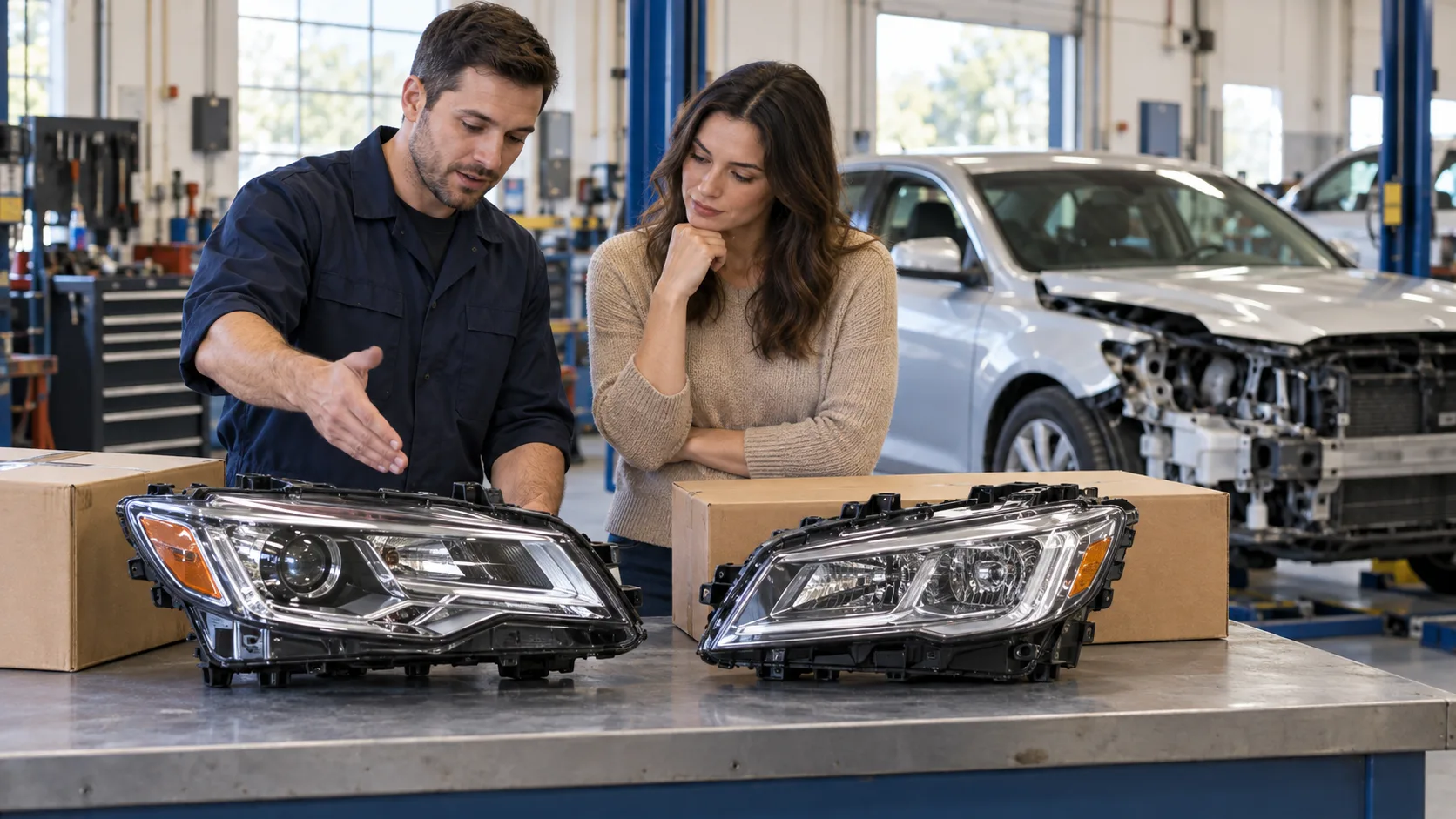
OEM parts are made for or by your car's manufacturer, and non-OEM aftermarket parts are made by other companies. In California, an insurer may specify aftermarket crash parts only if they are at least equal to OEM parts in kind, quality, safety, fit and performance, and the insurer must disclose and warrant them (10 CCR 2695.8(g)). Either type can be the right call, depending on the part, your car and your warranty.
Comparing OEM vs aftermarket parts for collision repair usually starts when a California driver sees "non-OEM" on an estimate and wonders if it is a downgrade. This comparison from Collision Assistant lays out the differences, the California disclosure rules and who should pick each type.
Parts decisions also shape the repair timeline, because a part on back order holds up the whole job. Collision Assistant tracks parts labels, parts delays and supplements in one file for every repair we coordinate, and the service is free for drivers.
Key takeaways
- California requires every crash part on a collision estimate to be identified as OEM or non-OEM aftermarket, and each part as new, used, rebuilt or reconditioned (Business and Professions Code 9884.9(c)).
- Under BAR's rule 16 CCR 3353(b), a new crash part listed on an estimate must be OEM unless the estimate identifies it as non-OEM aftermarket.
- An insurer that specifies non-OEM crash parts must warrant that they equal OEM parts and pay for any changes needed to fit them. It must also pay to replace a part that does not comply (10 CCR 2695.8(g)).
- The FTC says your vehicle warranty stays in effect if you use aftermarket or recycled parts; a manufacturer must prove such a part caused the damage before it denies coverage.
OEM vs aftermarket parts: comparison table
The table compares OEM, non-OEM aftermarket and used parts on who makes them, how California labels them and who stands behind them.
| Feature | OEM crash parts | Non-OEM aftermarket crash parts | Used or reconditioned parts |
|---|---|---|---|
| Who makes it | Made for or by the vehicle maker (16 CCR 3303(p)) | Not made for or by the vehicle maker (B&P 9875(c)) | Previously used parts, often OEM, taken from another vehicle or restored |
| Label on a California estimate | Treated as OEM unless marked otherwise (16 CCR 3353(b)) | Must be identified as non-OEM aftermarket (B&P 9884.9(c)) | Must be marked used, rebuilt or reconditioned (B&P 9884.9(c)) |
| Part warranty comes from | The vehicle maker or its parts program | The parts maker or distributor; insurer must also warrant equivalence when it specifies the part | The seller or the shop; ask for terms in writing |
| Extra insurer duties in California | None specific to the part type | Must equal OEM in kind, quality, safety, fit and performance; permanent maker ID; written disclosure (10 CCR 2695.8(g)) | Must be listed accurately on the estimate and invoice |
| Fit with vehicle maker procedures | Matches the maker's design reference | Varies by part and supplier | Matches original design if OEM, but condition varies |
| Typical reason chosen | Newer cars, sensor areas, lease terms, maker-required parts | Exterior panels on older cars where an equal part is available | Availability, older cars, matching original parts |
What is the difference between OEM and aftermarket crash parts?
The difference is who made the part. In its crash part definitions, BAR says an OEM crash part is made for or by the original vehicle manufacturer. A non-OEM aftermarket crash part is one "not made for or by the manufacturer of the motor vehicle."
A crash part, under Business and Professions Code 9875, is a replacement for the nonmechanical sheet metal or plastic parts that generally form the outside of the car, including inner and outer panels. Bumper covers, fenders, hoods and door skins are common examples. The definitions matter because the California disclosure rules apply to crash parts.
BAR also says shops may not use terms such as "opt-OEM," "alt-OEM," "QRP" or "LKQ" in place of these defined labels. If your estimate uses a code you do not recognize, ask the shop which defined category the part falls into.
What California rules apply to aftermarket parts on an insurance estimate?
California's Fair Claims Settlement Practices Regulations limit when an insurer can specify aftermarket crash parts. Under 10 CCR 2695.8(g), "No insurer shall require the use of non-original equipment manufacturer replacement crash parts" unless the parts are at least equal to OEM parts in kind, quality, safety, fit and performance. The text is on the Cornell LII copy of 10 CCR 2695.8.
When an insurer specifies non-OEM crash parts, 10 CCR 2695.8(g) makes it pay for any changes needed to make the parts fit. The insurer must also warrant that the parts are equal and disclose that warranty on its estimate. If a part that does not comply is installed, the insurer must pay to remove it and put in one that does.
Business and Professions Code 9875.1 adds a disclosure step. The written estimate must name the maker or distributor of each non-OEM crash part. A notice in at least 10-point type must also say that warranties on those parts come from their maker or distributor, not the vehicle maker.
Two more rules help drivers. Under 10 CCR 2695.8(h), an insurer may not require you to supply replacement parts. Under 10 CCR 2695.8(i), any betterment deduction must reflect a measurable change in market value, be itemized in dollars and apply only to parts normally replaced during the car's life, such as tires and batteries.
Do aftermarket parts void my car's warranty?
No, not by themselves. The Federal Trade Commission says, "Your warranty stays in effect if you use aftermarket or recycled parts" (FTC auto warranties guide).
The FTC adds that if a defective aftermarket or recycled part, or a bad installation, damages a covered component, the manufacturer or dealer can deny coverage for that damage. The FTC also says the manufacturer or dealer "must prove" the part caused the damage. Keep your final invoice, which lists every part by type under Business and Professions Code 9884.8.
Who should pick OEM parts?
OEM parts are often the better fit when the part sits near safety equipment or when the car's terms favor original parts. A part that mounts a radar, camera or airbag sensor affects how those systems read the road, and OEM gives the shop the maker's own design reference.
- Owners of newer cars with driver-assist sensors behind the bumper, grille or windshield. See ADAS calibration after a collision.
- Drivers whose lease or financing terms address repair parts. Check your contract.
- Repairs where the vehicle maker's procedure calls for a specific part. Ask the shop to show you the procedure.
- Drivers who prefer the maker's part where the insurer wrote an aftermarket one. Step 4 below shows how to raise it with the insurer.
Airbag parts may get their own rule. As of April 2026, BAR had proposed a rule that airbag replacement parts come from the OEM or an OEM-authorized supplier. That rule was not yet law (BAR Spring 2026 update).
Who should pick aftermarket parts?
Non-OEM aftermarket parts can fit well for cosmetic exterior panels on older cars when a part of equal quality is available. California's rules put the duty on the insurer to make sure a specified aftermarket crash part equals OEM and to pay for any fitting work.
- Owners of older cars where OEM parts are slow or no longer made.
- Repairs to outer panels that do not hold sensors or structural parts.
- Drivers paying out of pocket who want to compare prices line by line.
- Repairs where a used OEM part is the closest match to an older car's original design.
Example: a hypothetical 12-year-old sedan has a dented rear door skin and no sensors in that area. An aftermarket door skin that equals OEM in fit and finish, with its maker named on the estimate, can be a reasonable choice. The same driver might ask for OEM on a front bumper bracket that holds a radar.
Steps to take when your estimate lists aftermarket parts
When your estimate lists aftermarket parts, six steps tell you what you are getting and who stands behind it.
- Find each crash part on the estimate and check its label: OEM, non-OEM aftermarket, used, rebuilt or reconditioned.
- Confirm that each non-OEM crash part names its maker or distributor, as Business and Professions Code 9875.1 requires.
- Ask the shop which parts sit near sensors, airbags or structural areas, and whether the vehicle maker requires a specific part there.
- If you want OEM for a part, ask the insurer in writing whether it will pay for OEM and what any difference would be.
- Read the warranty notice for non-OEM parts and keep it with your estimate.
- At pickup, compare the final invoice to the estimate to confirm the parts installed match the labels.
Common mistakes with OEM and aftermarket parts
Most parts mistakes come from assumptions about quality or speed instead of reading the labels. Watch for these four.
- Assuming "aftermarket" always means low quality. California sets an equality standard for insurer-specified parts.
- Assuming OEM is always available quickly. Parts delays can stretch a repair and a rental.
- Not reading the parts labels. The labels are required, and they tell you what you are getting.
- Losing the invoice. The invoice is your proof of what was installed if a warranty question comes up.
How Collision Assistant helps
With our property damage claim management service, we keep the estimate, supplements and invoice in one file, and follow up on parts delays. We also line up the parts labels on the estimate next to the invoice so you can spot any change. We coordinate and document; the insurer decides coverage and payment.
Through our free body shop recommendation, we connect you with a BAR-registered shop in our California network that we check first, matched to your make and damage type. You keep your shop choice, and the service is free for drivers. Our guide on how to read a collision repair estimate covers the rest of the estimate.
Side-by-side comparison is how we help with shops, too. Kevin B. from Modesto described what it showed him:
"I almost went with the first shop that popped up on Google. Glad I didn't, that one had some rough reviews I only saw because Collision Assistant had them side by side with two others. Went with a higher-rated one a few miles further out. Worth the extra drive."
Kevin B., Modesto
Frequently asked questions
Can my insurer make the shop use aftermarket parts?
Only if the parts meet the 10 CCR 2695.8(g) standard of being at least equal to OEM in kind, quality, safety, fit and performance. The parts must also carry permanent maker identification and be disclosed in writing, and the insurer must warrant them and pay for any changes needed to fit them. Ask your insurer for its warranty terms in writing.
Can a shop switch an OEM part to aftermarket without telling me?
A shop should not, and California's labeling rules make a switch visible. The estimate you approved must label each crash part as OEM or non-OEM aftermarket under Business and Professions Code 9884.9(c), and the final invoice must use the same labels under Business and Professions Code 9884.8. If a part changes, ask for a revised written estimate and compare the labels on the final invoice before you sign.
Are used parts the same as aftermarket parts?
No. A used part has been on another vehicle and is often an OEM part, while a non-OEM aftermarket part is a new part not made for or by the vehicle maker. California requires the estimate to mark used, rebuilt and reconditioned parts separately from the OEM or non-OEM label, so you can see both facts on each line.
Do aftermarket parts lower my car's value?
The effect on value depends on the car, the part and the buyer, so there is no fixed answer. Under CACI 3903J, a California jury may consider a car's lost value after repair on a third-party claim. Keeping a complete repair record, including parts labels, helps any later review, and our diminished value claim guide explains the process.
Who pays if an aftermarket part does not fit?
When the insurer specified the non-OEM crash part, 10 CCR 2695.8(g) says the insurer must pay for modifications needed to make it fit. If the part turns out not to meet the equality standard, the insurer must pay to remove it and install a compliant part. Ask the shop to photograph and note any fit problem on the supplement so the insurer can review it.
Choose parts with the full picture
If your estimate lists parts you are unsure about, Collision Assistant can keep your estimate, invoice and parts records straight. Get a free quote or call 562-800-6904.
This article is general information, not legal, insurance or medical advice. Collision Assistant is not a law firm, insurer or medical provider.