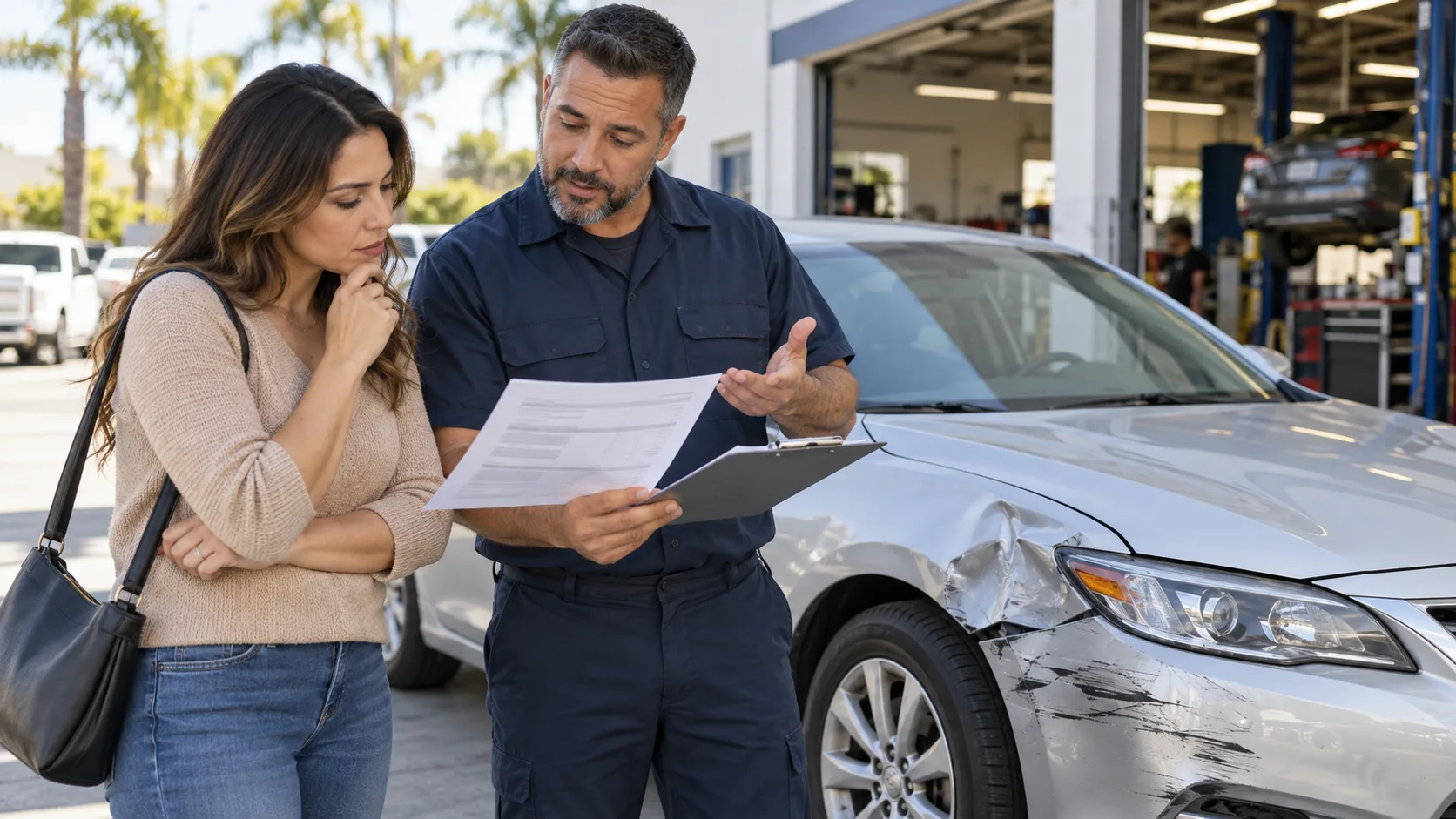
How to File a Car Insurance Claim After an Accident

Here is how to file a car insurance claim after an accident: call or go online with the insurer, report the date, place and facts of the crash, and write down the claim number you get. In California, the insurer then has 15 calendar days to acknowledge the claim, send forms and start investigating. Have your policy number, the other driver's details, photos and the police report number ready before you start.
This guide is for California drivers who need to open a claim now and want to get it right the first time. It covers what to gather, the filing steps in order, what happens in the first two weeks, and the short deadlines that catch people off guard.
Collision Assistant sees the same filing gaps again and again: a missing claim number, no record of who said what, or a car left at a tow yard. A clean start makes every later step easier, from the estimate to the rental to the final repair.
When should you file a car insurance claim?
File a car insurance claim as soon as you safely can after the accident. The California Department of Insurance accident guide tells drivers to notify their agent or insurer immediately, and most policies require prompt notice. Some coverages also carry short legal deadlines of their own.
Uninsured motorist property damage coverage is one example. Under Insurance Code 11580.26, the crash must be reported to your own insurer within 10 business days, and the at-fault driver or license plate must be identified. A late report can put that coverage at risk.
Will filing a claim count against you?
California has a specific test for when an accident can count against your driving record for rating. Under 10 CCR 2632.13, a driver is "principally at-fault" only if their actions were at least 51 percent of the legal cause of the accident. The accident must also involve injury, death or more than $1,000 in property damage.
The same rule presumes you were not principally at fault in several cases. These include being lawfully parked, being rear-ended without a moving violation conviction, or being hit by a hit-and-run driver when the crash was reported to authorities within a reasonable time. Your insurer can explain how a claim may affect your own policy.
What should you have ready before you file?
Before you file a car insurance claim, gather your policy number, the other driver's name, insurance and plate, the crash date, time and place, photos, and any police report number. Under 10 CCR 2695.5(e)(2), the insurer must tell you what information it needs as proof of claim, so this list gives you a head start.
| Item | Where to find it | Why the insurer asks |
|---|---|---|
| Your policy number | Insurance card or app | Opens the claim on the right policy |
| Other driver's name, address, license, insurer and policy number | Info you exchanged at the scene | Identifies the other party and their coverage |
| License plates and VINs | Vehicles, registrations, photos | Confirms the vehicles involved |
| Date, time and location | Your notes and phone photos | Sets the facts of the loss |
| Police or CHP report number | The officer's card or receipt | Lets the insurer request the report |
| Photos of damage and the scene | Your phone | Shows the damage before repairs |
| Witness names and phone numbers | Your notes | Supports the facts if fault is disputed |
| Where the car is now | Tow receipt or your address | Lets the insurer inspect it |
If you are still gathering this list, our guide on photos and information to get at the scene covers what to capture. If you left the scene without some of it, the police report can fill gaps. See car accident police report for how to request one.
How to file a car insurance claim, step by step
Filing a car insurance claim in California follows the same order with most insurers. These steps keep the record clean from day one.
- Decide which insurer to call. Call your own insurer, the other driver's insurer, or both. Tell your own insurer about the crash either way.
- Report the claim. Use the insurer's phone line, app or website. Give the date, time, place, vehicles and a short, factual account of what happened.
- Write down the claim number. Also note the adjuster's name, phone number and email, and the date you filed.
- Send your photos and documents. Upload or email them, and keep copies of everything you send.
- Tell the insurer where the car is. If the car is at a tow yard, ask how to move it to a shop so storage fees do not build up.
- Choose your repair shop. You pick the shop under Insurance Code 758.5. Get a written estimate from that shop.
- Watch for the acknowledgment. Expect forms and instructions within 15 calendar days of your notice.
- Keep a claim log. Record each call and email with the date, the person and what was said.
- File the DMV SR-1 if required. The insurance claim does not replace it.
The SR-1 rule comes from Vehicle Code 16000: report within 10 days if damage to anyone exceeds $1,000 or anyone is hurt. Our California SR-1 form guide walks through it.
Should you file with your insurer or the other driver's?
You can file with your own insurer, the other driver's insurer, or both. A claim on your own collision coverage does not wait for the other insurer to accept fault, but your deductible applies. A claim against the at-fault driver's property damage liability avoids your deductible but depends on that insurer accepting liability.
If your own insurer pays and the other driver was at fault, your insurer may seek repayment through subrogation. Under 10 CCR 2695.7(q), it must include your deductible in every subrogation demand. Our car accident insurance claim guide compares both routes in a table, and not-at-fault accident covers the case where the other driver caused the crash.
What happens in the first 15 days after you file?
In the first 15 calendar days after notice of claim, a California insurer must acknowledge the claim, give you the forms and instructions you need, and start any needed investigation, under 10 CCR 2695.5(e). If the insurer pays the claim within that time, it does not have to send a separate acknowledgment.
During this window, the adjuster may ask for a written or recorded statement, contact witnesses and inspect the car. The CDI accident guide says insurers may also request an examination under oath in some cases. If you send a question that calls for a reply, the insurer must respond within 15 calendar days under 10 CCR 2695.5(b).
After the insurer has proof of claim, it has 40 calendar days to accept or deny the claim under 10 CCR 2695.7(b). If it needs more time, it must tell you in writing and update you every 30 calendar days.
Can someone else file or handle the claim for you?
Yes: under 10 CCR 2695.5(c), you can name someone in writing to handle your claim, such as a family member. The designation must be signed and dated by you, state that the person is authorized to handle the claim, and be sent to the insurer. It lasts until the claim is settled or you revoke it in writing.
A written designation helps when the driver is far away, injured or busy. A parent managing a daughter's repair from two hours away is one example:
"My daughter's car got hit while it was parked and I was handling it from two hours away. Being able to find a trustworthy shop near her, check it out, and set it up without driving down there myself saved me a whole day off work."
Lorena M., Bakersfield
What should you say when you report the claim?
When you report a car insurance claim, stick to facts you know: where you were, what you saw, the vehicles and the damage. Do not guess about speeds, distances, injuries or repair costs. If you are unsure, say you are unsure.
Injuries are a separate matter, and some symptoms appear later: MedlinePlus says whiplash pain can take hours to weeks to develop. Get checked by a doctor, and read delayed injury after a car accident. This is not medical advice.
Keep written notes of every call. If something important was agreed by phone, send a short email that repeats it, so the claim file has a written record.
Common mistakes
- Not writing down the claim number, adjuster name and date filed.
- Assuming the insurance claim covers the DMV SR-1 report, when DMV says law enforcement will not file it for you.
- Waiting too long on an uninsured driver claim, when uninsured motorist property damage has a 10-business-day reporting rule.
- Not telling the insurer where the car is, so the inspection waits while tow yard storage adds up.
- Going with the first shop that shows up on Google without comparing reviews.
- Filing without the police report number, so the insurer has to track down the report before it can look at fault.
For a wider list, see car accident mistakes to avoid.
How Collision Assistant helps
Collision Assistant helps California drivers get the vehicle side of a new claim set up, and the service is free for drivers. Our intake gathers your contact details, photos, police report number, claim numbers, vehicle details and which coverage the repair runs through.
- We put every document under one case number, so nothing gets lost between calls.
- On request, we place your car with a shop in our vetted California network and start the written estimate.
- Before we recommend a shop, we confirm its Bureau of Automotive Repair registration is active.
- We coordinate towing for a non-drivable car so it does not sit at a tow yard.
- We send status updates until you have the keys back.
You keep the right to choose any licensed shop. See our property damage claim management service or ask for a free body shop recommendation. Collision Assistant coordinates and documents; we do not settle claims or give legal advice.
Getting Your Car Handled While the Claim Runs
The filing itself is the small part. Being organized beforehand, factual during, and patient afterward covers most of what determines how smoothly things go. And in California you have more protection than most drivers realize, from surcharge rules to insurer deadlines to your right to choose who fixes your car.
When you're ready for that last part, we'll help you find and connect with a vetted, verified California repair shop and request a repair quote, all for free. Walk into your claim knowing what the damage really costs, and the rest of the conversation gets a lot shorter. Reach out through our site whenever you're ready.