How to Maximize Your Insurance Claim After an Accident
To maximize your insurance claim after an accident means making sure every covered loss is documented and submitted, not squeezing the insurer. In California, that usually comes down to five things: full documentation, supplements for hidden damage, rental or loss of use, a checked total loss valuation, and diminished value on third-party claims. Insurers decide coverage and payment, and no step promises a higher amount.
Many drivers lose part of a claim through gaps, not through a bad offer. A part found at teardown never makes it into a supplement, a rental ends before the repair does, or a total loss offer is signed before anyone checks the comparable cars.
Collision Assistant works on the repair side of California claims, so these are the gaps we see most. This guide covers each one, with the California rule that applies and what to keep in your file.
Key takeaways
- 10 CCR 2695.7(g) bars unreasonably low settlement offers, and one factor regulators weigh is how far the insurer considered the evidence the claimant submitted.
- Hidden damage found at teardown is added to a claim through a supplement, and a California shop must get your consent before charging more than its written estimate (Business and Professions Code 9884.9).
- A total loss payment must include applicable taxes and one-time transfer fees for a comparable car, under 10 CCR 2695.8(b).
- Diminished value is usually pursued on a third-party claim, and CACI 3903J allows it when a car is worth less even after repair.
- Loss of use is measured as the reasonable cost to rent a similar car for the time reasonably needed to repair or replace yours (CACI 3903M).
What does it mean to maximize your insurance claim?
To maximize your insurance claim means getting every covered loss in front of the insurer with proof, so the claim is decided on complete facts. It does not mean inflating damage or arguing for a number. In California, whether an insurer considered the evidence you submitted is one factor regulators use to judge if an offer was unreasonably low.
The rule in 10 CCR 2695.7(g) bars any insurer from trying to settle a claim with an "unreasonably low" offer. One factor the Insurance Commissioner weighs is "the extent to which the insurer considered evidence submitted by the claimant to support the value of the claim." Evidence you never send cannot be weighed.
Collision Assistant's role fits that rule: we coordinate, document and follow up on the vehicle side so the evidence reaches the insurer. The insurer makes the payment decision.
What should you document after an accident?
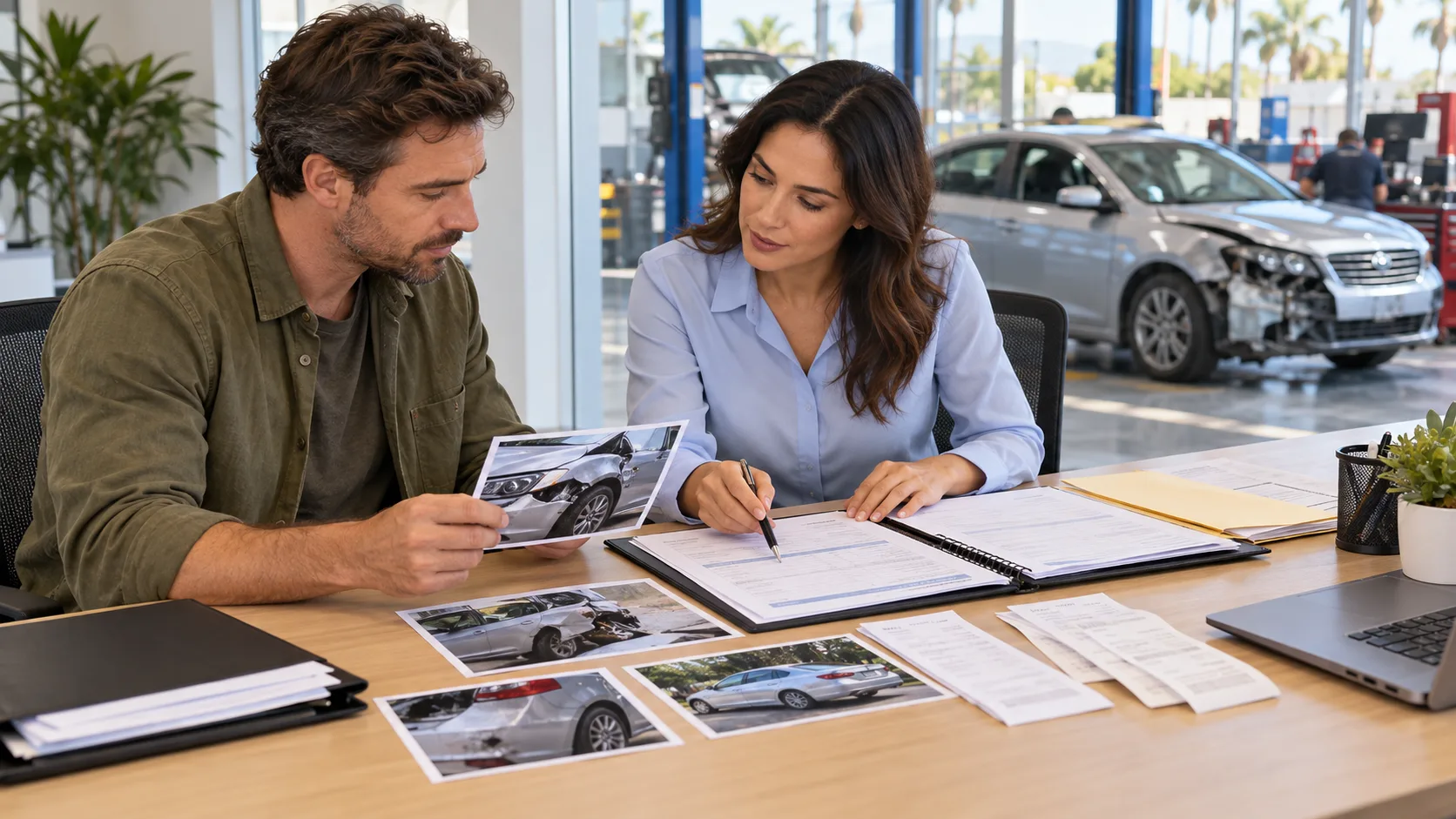
Document the car's damage, the scene, every cost you pay and every conversation with an insurer. Photos from all sides before any repair, tow and storage receipts, rental records and a dated call log make up the core of the file. Some of these records disappear fast, such as tow yard paperwork and scene photos.
| Record | What it supports | Keep it from |
|---|---|---|
| Damage photos from all sides, plus close-ups | Repair scope and hidden damage supplements | The scene and before any repair |
| Odometer photo and pre-crash service records | Total loss condition and mileage | Before the car is towed or sold |
| Tow and storage receipts | Towing and storage charges (10 CCR 2695.8(k)) | The tow company and storage yard |
| Rental agreement and receipts | Rental or loss of use | The rental company |
| Shop's written estimate and every supplement | The full repair amount | Your repair shop |
| Final repair invoice | What was replaced, and diminished value | Your repair shop |
| Call and email log with dates and names | Deadlines and what was agreed | Day one of the claim |
For the scene itself, see photos and information to get at the scene. If anyone was hurt, get checked by a doctor: the CDC says some concussion symptoms may not appear for hours or days. This is not medical advice.
How do supplements add hidden damage to a claim?
A supplement is an added estimate for damage found after the first estimate, usually when the shop takes the car apart. The shop documents the new damage with photos and parts lists and sends it to the insurer for review. A common myth is that the first estimate is the final price; supplements are normal when teardown finds more damage.
California protects you on the shop side too. Under Business and Professions Code 9884.9, a shop may not charge more than its written estimate unless you consent after learning the estimate is short and before the extra work is done.
If the insurer's estimate is lower than your shop's, 10 CCR 2695.8(f) says the insurer must pay the difference, name a shop that will repair it for the insurer's estimate, or make itemized, reasonable adjustments.
Example (hypothetical): An SUV is hit in the front corner in Riverside, and the first estimate covers a bumper cover and a headlamp. At teardown, the shop finds a bent radiator support and a cracked radar bracket. The shop sends a supplement with teardown photos, and the radar calibration is added to the repair plan.
Read more in hidden damage after a car accident and how to read a collision repair estimate.
How do rental and loss of use fit into a claim?
On your own policy, rental is paid only if you bought rental reimbursement coverage, which the California Department of Insurance auto guide describes as optional. On a third-party claim, loss of use is part of your damages against the at-fault driver.
California's jury instruction CACI 3903M measures loss of use as the reasonable cost to rent a similar vehicle for the time reasonably needed to repair or replace it. The key phrase is "reasonably needed," which is why the shop's written timeline matters when parts are delayed.
Rental trouble usually starts when the repair outlasts the insurer's cutoff date and nobody asks for more days in time. Our guide on rental car after an accident covers cutoffs and extension requests.
How should you check a total loss valuation?
Check that the valuation uses real comparable cars and itemized adjustments. Under 10 CCR 2695.8(b), comparables must be the same make, the same or newer model year, of like kind and quality, and identified by VIN, stock number or plate. Condition deductions must be "discernible, measurable, itemized, and specified."
The total loss payment must also include all applicable taxes and one-time fees to transfer ownership of a comparable car, plus license fees for the rest of your registration term. If you cannot find a comparable car for the amount offered, tell the insurer within 35 calendar days, under 10 CCR 2695.8(c). The insurer must then reopen the file and find a comparable, pay the difference or use the policy's appraisal clause.
In the files we see, the costly slip is signing before anyone has checked the comparables. See how California insurers decide a total loss for the full rules.
When can you claim diminished value?
Diminished value is the drop in a car's market value after a crash, even when it is repaired well. Under CACI 3903J, if a car is worth less even after repair, the at-fault driver may owe the reduced value plus repair cost, up to the car's pre-crash value.
A common myth is that your own collision coverage pays diminished value, but generally it does not. In Baldwin v. AAA (2016), a California appeals court held that a policy with a repair option and a diminution-in-value exclusion does not owe it. Diminished value is usually pursued on a third-party claim, as our diminished value claim guide explains.
A checklist for a complete claim file
Use this checklist to make sure each part of the vehicle claim has been submitted with proof. Each item matches a loss California rules recognize.
- Photos of all damage, the scene and the odometer, taken before repairs.
- A written, itemized estimate from the shop you chose, with each part labeled OEM or aftermarket.
- Every supplement for hidden damage, with photos from teardown.
- ADAS calibration listed on the estimate if the car has driver-assist sensors near the damage.
- Tow and storage receipts, and the date the car left the tow yard.
- Rental agreement, receipts and any extension requests tied to the shop's timeline.
- For a total loss: the valuation report, the listed comparables and your notes on each.
- For a third-party claim: a diminished value estimate based on the final repair invoice.
- A dated log of every call and email with each insurer.
For sensors and parts, see ADAS calibration after a collision and OEM vs aftermarket parts.
Common mistakes
- Treating the first estimate as final, so hidden damage never reaches the insurer.
- Letting a rental run past the cutoff without a written extension request backed by the shop's timeline.
- Leaving the car in tow yard storage without asking the insurer when its payment for storage will end.
- Accepting a total loss figure without checking whether the taxes, fees and comparable cars in the report add up.
- Expecting your own collision coverage to pay diminished value.
- Throwing away receipts for towing, storage and rental.
If an offer still looks low after the file is complete, our guide to a lowball insurance offer explains how to review it and respond in writing.
How Collision Assistant helps
Collision Assistant builds and tracks the vehicle side of the claim file for California drivers, at no cost to the driver. We coordinate, document and follow up; we do not represent drivers or give legal advice.
- Hidden damage found at teardown goes back to the insurer as a supplement, and we track supplements, parts delays and completion dates.
- We line up the rental with whichever carrier is paying and ask for more days before the cutoff, using the shop's repair timeline as support.
- On a total loss, we compare the valuation report with California's rules on identified comparable cars and itemized adjustments.
- We prepare a diminished value estimate on third-party claims from the repair record.
- We keep estimates, supplements, invoices, rental records, photos and carrier letters in one file under one case number.
Repair quality shapes the file too, since the final invoice is the record behind any diminished value estimate. One Modesto driver compared shops before choosing:
"I almost went with the first shop that popped up on Google. Glad I didn't, that one had some rough reviews I only saw because Collision Assistant had them side by side with two others. Went with a higher-rated one a few miles further out. Worth the extra drive."
Kevin B., Modesto
Every shop we recommend holds an active Bureau of Automotive Repair registration, and you keep the choice of shop. See property damage claim management or request a body shop recommendation.
Frequently asked questions
Will documenting everything get me more money?
Documentation does not promise any amount, because the insurer decides coverage and payment; it makes sure each covered loss is in the file with proof. When regulators judge whether an offer was unreasonably low under 10 CCR 2695.7(g), one factor is how far the insurer considered the evidence the claimant submitted. A loss that was never documented or submitted cannot be weighed at all.
Can I add damage after the insurer approved the estimate?
Yes: damage found after the first estimate, usually at teardown, is sent to the insurer as a supplement with photos and a parts list. The insurer reviews the supplement like the first estimate. On the shop side, Business and Professions Code 9884.9 requires your consent before a shop charges more than its written estimate, so you will hear about added work before it is done.
Does the total loss payment include sales tax and fees?
Under 10 CCR 2695.8(b), a total loss cash settlement must include all applicable taxes and one-time fees incident to transferring ownership of a comparable vehicle, plus license and other annual fees for the remaining term of your registration. Check the valuation report for these lines. If they are missing, ask the insurer in writing to explain.
Is there a deadline to dispute a total loss value?
Yes, for one situation: under 10 CCR 2695.8(c), you have 35 calendar days after the payment or final offer to tell the insurer that no comparable car is available for that amount, and the insurer must then reopen the file. Save each dealer listing you checked, with the date, price and mileage, so your notice is backed by proof. For other disagreements, ask the insurer in writing to explain each comparable and adjustment.
Can I claim diminished value if I was partly at fault?
Possibly, but your share of fault reduces it. Under Li v. Yellow Cab Co. (1975), California uses pure comparative negligence, so your recovery from the other driver drops in proportion to your own share of fault. Diminished value is a third-party damages item under CACI 3903J, and fault or legal questions are for a licensed California attorney.
If you want help building a complete file for the vehicle side of your claim, Collision Assistant coordinates it for free. Get a free quote or call 562-800-6904.
This article is general information, not legal, insurance or medical advice. Collision Assistant is not a law firm, insurer or medical provider.