Paintless Dent Repair vs Traditional Repair for Your Car
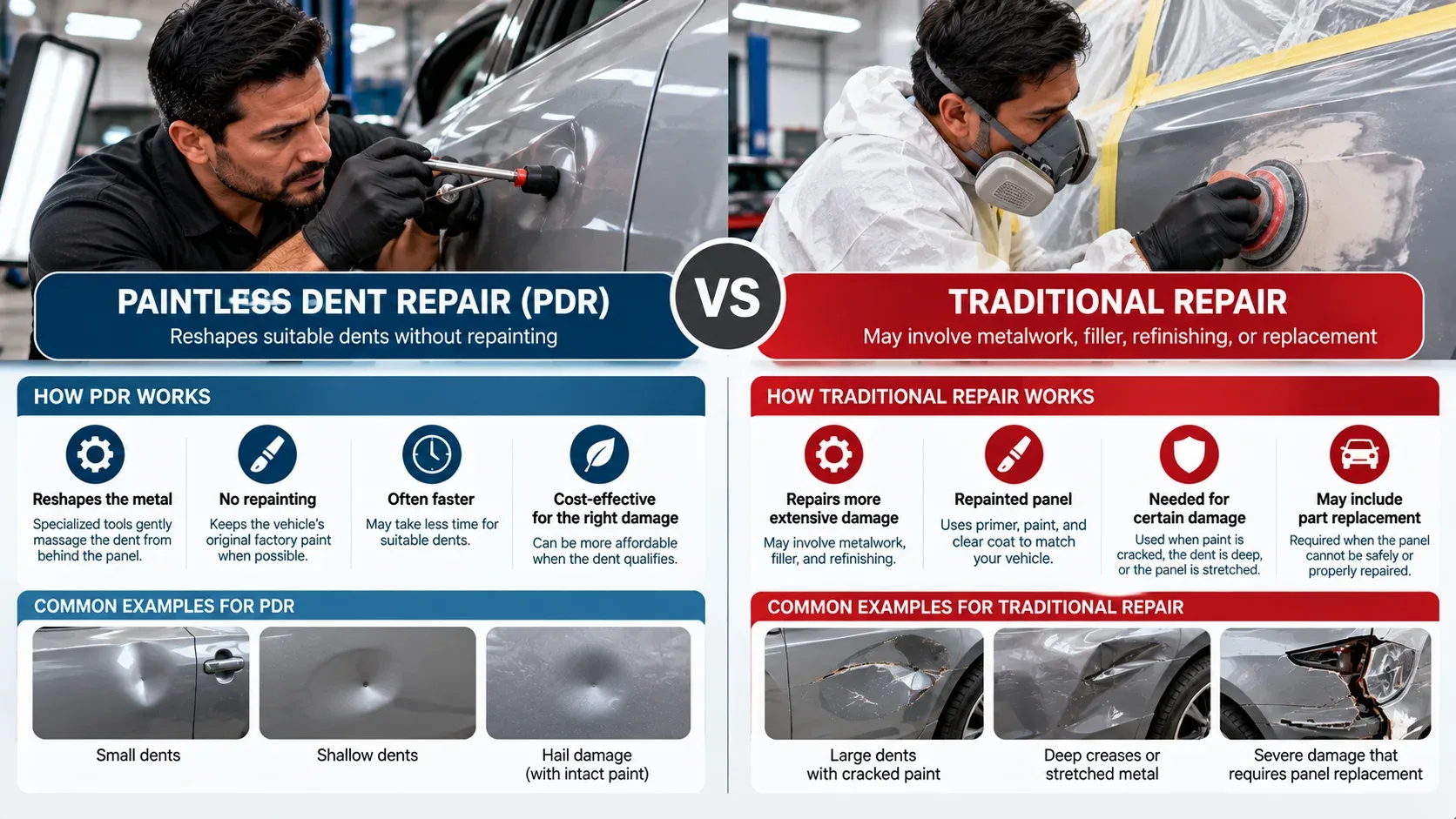
Paintless dent repair vs traditional repair is a choice about how to restore a damaged panel. PDR reshapes suitable dents without repainting, while conventional repair may involve metalwork, filler, refinishing, or replacement. The right approach depends on paint condition, damage shape, access, panel material, and manufacturer instructions. Have the damage assessed before choosing a method.
By Collision Assistant
For California drivers, a useful recommendation should explain why a method fits the specific panel. A small dent is not automatically a PDR job, and a request to preserve the original paint should not override the vehicle’s repair requirements.
Collision Assistant helps drivers connect with vetted collision repair shops. We do not perform dent repairs. This comparison explains what to ask during an assessment and how the options fit into the wider collision repair process.
Paintless Dent Repair vs Traditional Repair at a Glance
PDR focuses on restoring panel shape while retaining suitable paint. Traditional repair can also address work requiring surface preparation, refinishing, or panel replacement. Neither method should be chosen from a price comparison before repair suitability is established.
Use these questions when discussing PDR vs conventional dent repair with an estimator.
|
Comparison Point |
Paintless Dent Repair |
Traditional Repair |
What to Ask |
|
Paint |
Aims to preserve the existing finish |
Includes refinishing when needed |
Is the coating intact, including close inspection for cracking? |
|
Panel condition |
Requires damage suitable for controlled reshaping |
May involve metal repair or replacement, as permitted |
What finding supports the recommended method? |
|
Access |
May use existing access or an approved exterior pulling method |
Access work depends on the repair procedure |
What needs removal, and are any access methods prohibited? |
|
Materials |
Avoids filler and new paint for a successful paintless correction |
May include filler, primer, paint, and related materials |
Which products and operations are actually needed? |
|
Additional work |
May require reassembly and restoration of disturbed protection |
May require similar supporting work plus refinishing operations |
What does the complete estimate include? |
|
Cost and schedule |
Depend on the dent, access, and associated work |
Depend on the full repair scope and required materials |
What assumptions could change the estimate or completion date? |
What Does Each Repair Method Involve?
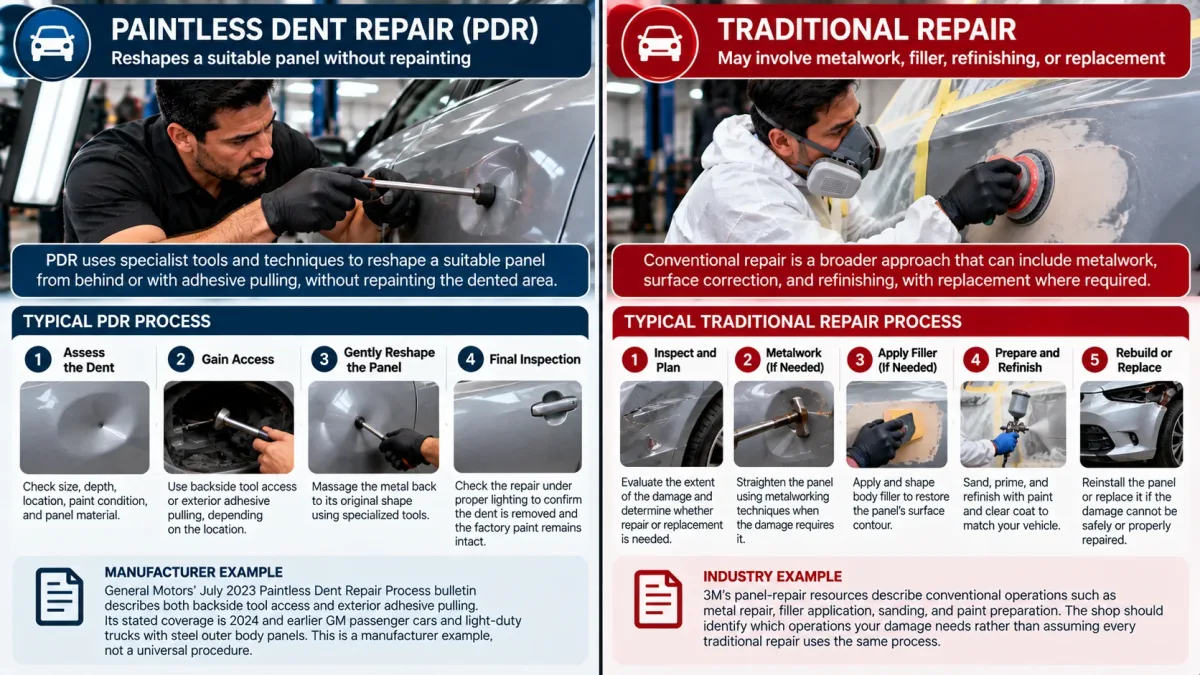
Paintless dent repair uses specialist tools and techniques to reshape a suitable panel without repainting the dented area. Conventional repair is a broader approach that can include metalwork, surface correction, and refinishing, with replacement where required.
General Motors’ July 2023 Paintless Dent Repair Process bulletin describes both backside tool access and exterior adhesive pulling. Its stated coverage is 2024 and earlier GM passenger cars and light-duty trucks with steel outer body panels. The bulletin is a manufacturer example, not a universal procedure.
3M’s panel-repair resources describe conventional operations such as metal repair, filler application, sanding, and paint preparation. The shop should identify which operations your damage needs rather than assuming every traditional repair uses the same process.
Ask the estimator to distinguish repairing the panel from replacing it. A recommendation for conventional repair does not automatically mean the entire panel must be replaced.
Which Paintless Dent Repair Limitations Matter Most?
The main paintless dent repair limitations concern the finish, the panel’s condition, access, and vehicle-specific restrictions. A technician needs to evaluate those factors together.
Paint Condition
Dent repair without repainting cannot restore paint that already needs refinishing. Tell the shop about previous paintwork and ask how it will check the existing coating before attempting PDR.
Rivian’s repair guidelines dated April 28, 2026 require close inspection for tiny paint cracks before and after PDR. Under those guidelines, these cracks require refinishing, and paint damaged by attempted PDR must also be repaired. These are Rivian-specific instructions.
Damage Shape and Location
Ask whether the dent’s shape, panel contour, or location prevents a paintless correction. Size alone should not be your decision rule.
The GM bulletin lists cracked paint, certain sharp dents, edge damage, and access restrictions among reasons PDR may be inappropriate. It also identifies some larger dents and soft dents in body lines as possible candidates. The applicable vehicle procedure remains the reference.
Tool Access
Limited access does not always end the assessment, because an approved exterior pulling technique may be an option. However, cutting a new access point is not an acceptable shortcut under I-CAR’s PDR guidance.
I-CAR’s guidance on access holes says not to drill holes or remove foam to perform PDR. Ask how the technician plans to reach the damage without making prohibited changes.
Panel Material
Do not assume that aluminum automatically rules out PDR, or that every steel panel qualifies. Rivian allows PDR on steel and aluminum subject to its vehicle-specific table of materials and permitted operations. Ask the shop to confirm the material and repair restrictions for your panel.
Does Paintless Mean No Disassembly or Additional Work?
No. Paintless describes the intended finish outcome. It does not establish that no trim, lamps, liners, or other components need removal, or that no protective treatment is required afterward.
Ask for access and reassembly work to be explained on the estimate. Also ask whether the work will be performed at the shop or by an outside specialist.
I-CAR’s PDR corrosion-protection guidance explains that tools can disturb protective coatings behind a panel even when the outer finish does not need repainting. Its curriculum calls for restoring that protection.
For a paintless dent repair vs traditional repair comparison, this is a useful check: does each proposal include all the work needed to complete the job, rather than just remove the visible dent?
When Should You Consider Conventional Repair?
Consider conventional repair when a qualified repairer identifies work that PDR cannot appropriately complete. Ask what condition rules out a paintless result and whether the panel can be repaired or needs replacement.
Useful questions include:
-
Does the finish need repair independently of the dent?
-
Can the panel be reshaped using a permitted method?
-
Are damaged attachments or other components involved?
-
Does the manufacturer restrict repair at this location?
-
Is the recommendation based on inspection or only photographs?
Hypothetical example: A door has a shallow dent and a separate area of damaged paint. PDR might address the shape if permitted, but it would not complete the paint repair. Ask the shop to explain both needs and the proposed finished result.
If the impact may have affected more than the outer panel, a cosmetic assessment is only part of the job. Our guide to hidden damage after a car accident explains why further inspection may be necessary.
How Should You Compare Prices and Completion Times?
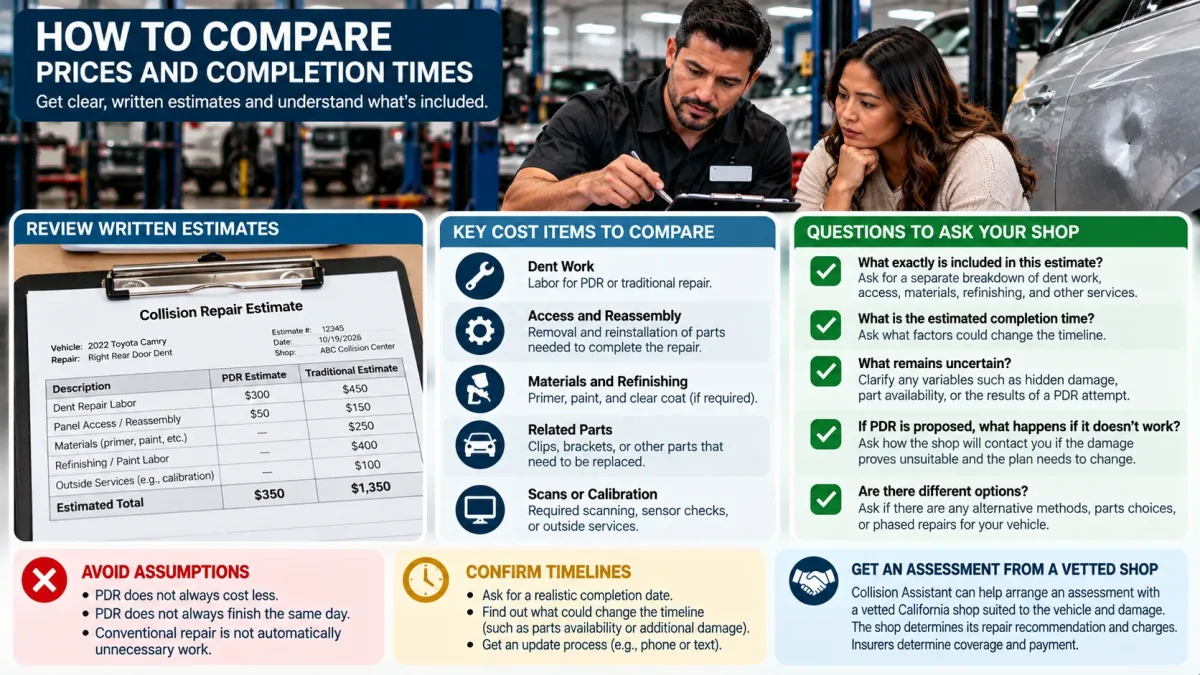
Compare written estimates for the complete proposed work. Avoid assuming that PDR always costs less or finishes the same day, or that conventional repair automatically represents unnecessary work.
Ask each estimator to separate the dent work from access, reassembly, materials, refinishing, and outside services. For an explanation of the document, see our guide to reading a collision repair estimate.
Ask what remains uncertain before accepting a completion date. If a paintless attempt is proposed, clarify how the shop will contact you if the damage proves unsuitable and the plan needs to change.
Collision Assistant can help arrange an assessment with a vetted California shop suited to the vehicle and damage. The shop determines its repair recommendation and charges. Insurers determine coverage and payment.
What Should You Confirm Before Authorizing Repairs?
Confirm the method, expected result, complete price, access work, and approval process for changes. In California, the shop needs your authorization before performing repairs.
The California Bureau of Automotive Repair, or BAR, explains in its consumer repair guidance that customers are entitled to an estimate, must authorize repairs, and must approve additional repairs. Keep copies of the estimate and subsequent changes.
Before proceeding:
-
Ask why the proposed method fits the dent and vehicle.
-
Explain any known previous paint or body repairs.
-
Confirm which parts must be removed for access.
-
Ask about inspection of the finish and restoration of disturbed protection.
-
Clarify whether another business will perform any work.
-
Agree how changes will be explained and authorized.
BAR’s Write It Right guide, updated January 2026, explains that sublet repairs require customer consent and disclosure with the estimate. The repair business remains responsible for that work.
At pickup, review the completed work and raise concerns with the shop. Our post-repair inspection checklist covers that separate stage.
Choose the Method That Fits the Damage
Your paintless dent repair vs traditional repair decision should follow the panel assessment, manufacturer instructions, and complete repair plan. Ask the shop to explain its reasoning and document the work you are authorizing.
If you need help finding a suitable California facility, request a body shop recommendation from Collision Assistant. We connect drivers with vetted shops and help arrange the estimate. The referral is free, while vehicle repairs and outside charges are separate.